
Costs & Pricing
How to Handle Job Variations and Extras on Site Without an Awkward Chat
'Could you just have a look at the other tap?' How to handle job variations and extras on site, agree the price in thirty seconds, and get paid for them.
 13 min read

Job variations, the extras and changes that crop up halfway through a job, are where small trade businesses quietly lose more money than almost anywhere else.
"While you're here, could you just have a quick look at the other tap?"
You say yes. Of course you do. It's a nice customer, it's a small thing, and it would feel petty to mention money. Twenty minutes later the tap is fixed, the customer is delighted, and you're loading the van, already thinking about the next job.
Then you sit down to do the invoice and realise the extra work isn't in the quote, you didn't note the time, and you're not quite sure what you'd have charged. So you let it go. Again.
If that happens often, the loss isn't small. This guide is about job variations, which is the proper name for any work that changes from what was agreed. It covers why they are so easy to lose, a thirty-second routine that settles them on the spot, and one distinction between three kinds of change that helps you decide what to charge and how to say it.
Where the money goes when nobody says the word "extra"
Think about what happens in the moment a customer asks for something additional.
There's a social pull to say yes without discussing price. Everyone is standing in the kitchen. The customer is friendly. Asking "and how would you like to pay for that?" feels clumsy.
So you agree, and the price floats in the air, unspoken. Each of you assumes something different.
You might think: I'll sort that out on the invoice. The customer might think: that's nice of them, it'll be a small thing.
Neither of these is a plan. When the invoice arrives with an extra charge, the customer is surprised. When it doesn't, you've worked for nothing.
That gap between assumptions is where relationships get strained and profit disappears. And the cause isn't dishonesty on either side. It's silence.
The cure isn't to become pushy. It's to make the price conversation so quick and natural that it stops feeling like a conversation at all.
The three kinds of change, and why they need different handling
Not every variation is the same. Treating them all alike is one reason people find the subject confusing. There are three kinds, and each has its own approach.
Kind one: the customer asks for more.
This is the "while you're here" request. It's a choice the customer makes, so it's natural for them to pay for it. It's also the easiest to price, because you can decide before you start.
Kind two: the job turns out different from what anyone could see.
You open the wall and find old pipework. You lift the floor and discover rot. The job has changed, and not because anyone asked. Here the conversation is about information: this is what I found, this is what it means, and these are the options.
Kind three: the mistake is yours.
You misjudged the time, forgot an item or quoted without checking. This is a cost of your own business, not a variation, and it shouldn't be passed to the customer. It does belong in your job costing, though, so you learn from it. Our job costing guide shows how.
Knowing which kind you're facing changes your tone.
For kind one, you're offering a service. For kind two, you're advising. For kind three, you're quietly improving.
Most awkward conversations happen because someone mixed these up. A customer who asked for nothing gets a bill as though they had asked for extras. Or a genuine discovery is treated as the customer's fault.
The thirty-second routine that settles it before you pick up a tool
Here's the routine in four moves. It takes about half a minute, and once you've done it a few times it will feel as ordinary as asking how someone takes their tea.
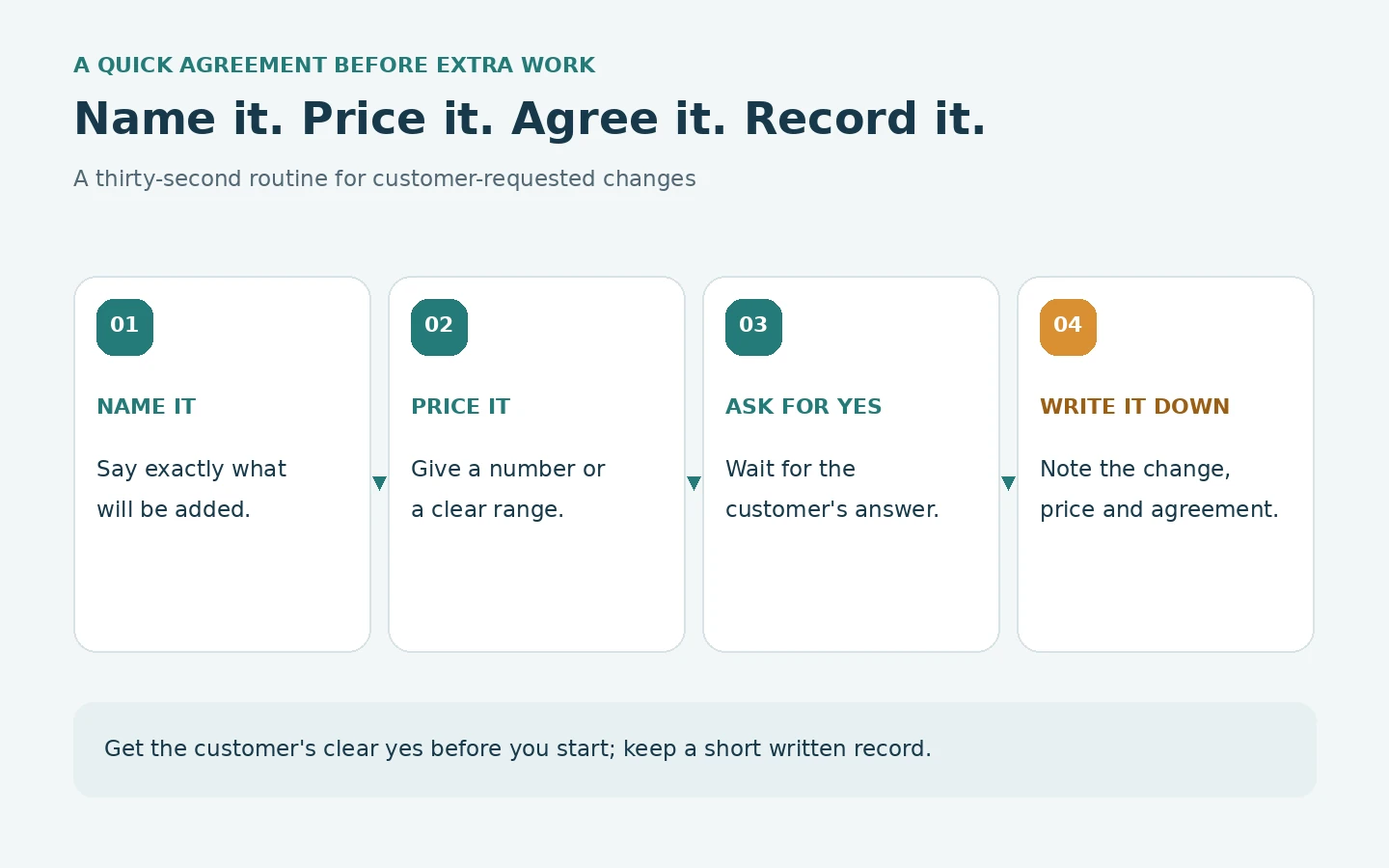
Move one: name it. Say what the extra is, in plain words. "So you'd like the second tap replaced as well."
Move two: price it. Give a number, or a clear range. "That would be about forty-five minutes and a tap, so $X."
Move three: ask for the yes. "Shall I go ahead?" Wait for an answer.
Move four: write it down. Send a quick message or note it on your phone. "Added: replace second tap, $X."
That's it. Name, price, ask, write.
The reason this works is that every move removes a source of confusion. Naming it avoids misunderstanding. Pricing it removes the surprise. Asking turns a vague nod into a decision. Writing it down means it won't vanish by invoice time.
You don't need a clever script. You need the habit of saying the number out loud before you start.
Pricing the extra in your head, fast, when you have no price list
The routine falls apart if you can't price the extra on the spot. If you hesitate for a minute, the moment feels heavy.
There are two ways to prepare.
Pre-price your common extras. Think of the ten things customers most often ask for while you're there. A second tap. An extra socket. A shelf. A door adjustment. Work out a price for each, and keep the list somewhere you can see on site. A card in the van, a note on your phone, or a saved list in your software all work.
Learn to price in time blocks. For anything unusual, think in half-hour or hour blocks. "That's about an hour, so $X plus materials." Use your normal hourly figure. If you haven't worked that out yet, our guide to working out your hourly rate takes you through it.
If you genuinely can't say, there's an honest middle path: "I'm not sure how long that will take. Let me look, and I'll give you a price in five minutes before I start." Customers respect that far more than a vague "we'll see".
What you should avoid is the phrase "I'll sort it on the invoice". It feels friendly, and it's the root of most arguments about variations.
What to say when the job has changed and it isn't anyone's fault
This is the harder case. You've opened something up and the situation is different from what you quoted for. The customer is standing there, perhaps worried, perhaps cross, and probably unsure what to do.
The key is to separate three things: what you found, what it means, and what the options are. Do it in that order.
What you found. Show them if you can. A photo on your phone is better than a description. "This is the pipe behind the wall. You can see the corrosion here."
What it means. Explain the consequence in simple words. "It will need replacing before we can fit the new unit, otherwise it may leak."
What the options are. Give at least two, with a price and a consequence for each. "I can replace the section now, which adds about two hours and $X for materials. Or I can finish the job as quoted and leave that section, but I wouldn't recommend it."
Notice what this does. It treats the customer as a decision-maker, not an obstacle. It shows evidence rather than asking for trust. And it gives them a choice, which makes people feel less trapped.
Afterwards, put the decision in writing. "Thanks for confirming. We'll replace the corroded pipe section for an extra $X, as discussed."
Our guide on writing job notes that protect you in a dispute covers how to record this without it taking an hour.
Photos: the cheapest insurance you can carry
If there is one habit that makes variations easier, it's taking a photo.
When you find something unexpected, photograph it before you touch it. When the customer requests an extra, photograph the area. When the work is finished, photograph that too.
A photo does several things at once.
- It shows the customer what you're talking about, which cuts the time needed to explain.
- It makes your explanation credible, because it isn't just your word.
- It creates a record, which helps if there's ever a disagreement about what was there or what was done.
- It reminds you, when you're writing the invoice, of exactly what happened.
Make sure the photo is saved against the right job and can be found later. A camera roll full of pictures with no labels is little help. Many job-management tools let you attach photos to a job from your phone, but check that this works smoothly on your own device before you rely on it. We cover the habit in more detail in our guide to before-and-after photos for tradespeople.
Writing it down without writing an essay
The "write it down" step is where most people slip, because it feels like paperwork. The answer is to make it small.
You don't need a form. You need three things in one place: what changed, what it costs, and that the customer agreed.
Here are some ways to do it.
- A text message to the customer. "Hi, confirming we've added a second tap replacement for $X. Thanks." The customer replies "OK" or a thumbs-up. That's a record on both phones.
- A note on the job in your software. Type or dictate a sentence and attach it to the job.
- A signature on your phone or tablet. For larger changes, you can ask the customer to sign a short note.
- A line on a paper pad. Date, change, price, initials. Photograph it.
The best method is whichever one you will actually use on a busy afternoon. A perfect system you skip is worse than a messy one you keep.
For bigger changes, a short written variation is worth the extra minutes. Include a description of the change, the price, any effect on the time the job will take and the customer's agreement. Keep it in plain words.
Getting variations onto the invoice, not left in your head
Writing it down only helps if it reaches the invoice. Many variations are agreed on site and lost at the desk.
A simple habit prevents this. At the end of every job, before you leave, look at your notes and ask: "Did anything change?" If the answer is yes, add it to the job immediately, while you're still on site.
Then, when you create the invoice, show the variation as a separate line. Don't bury it in the total.
"Replace second tap (agreed on site): $X"
This does two things. It reminds the customer that they asked for it. And it shows that the original price hasn't changed.
If the customer queries the charge, you have the text, the photo or the note to point to. In most cases, you won't need it. The query disappears as soon as they see their own request written down.
It also helps to check, before you send the invoice, that the quoted price, the variations and the deposit all add up in a way the customer can follow. Our invoicing guide walks through getting the final invoice right.
The scope edge: how to stop most variations before they begin
Prevention is better than negotiation. A lot of variations happen because the original scope was fuzzy.
Think of your quote as a line drawn around a piece of work. Everything inside is included. Everything outside is extra. If the line is blurry, customers will assume that more is inside it than you intended.
You can sharpen the line in three ways.
Say what's included. "Supply and fit one mixer tap, remove the old tap, test for leaks." A clear description leaves less room for "I thought that was part of it".
Say what's not included. "Does not include making good tiles or decoration." It's much easier to say this before the work than during it.
Say what might change. "If the pipework behind the wall is different from what we can see, the price may change, and I'll tell you before going ahead." This prepares the customer for kind two changes.
Adding these three lines to your quotes costs you almost nothing. They turn many future arguments into simple confirmations, because the customer has already agreed to how changes will be handled.
Our guide to writing quotes that win more trade jobs goes further into scope, exclusions and clarity.
Should you ever do an extra for free?
Sometimes, yes. The question is how to do it without teaching customers to expect it.
Doing a small extra for nothing can be a good business move. It can win a review, a recommendation or a regular customer. The trouble is when it is done silently, because the customer doesn't see it as a gift. They see it as normal.
If you want to give something away, make it visible:
"That's about ten minutes, so I'll include it as a thank-you."
Then add it to the invoice as a line with a zero price, or a note saying "included". The customer sees the value, and you've kept the record.
It also helps to decide your own rule. Perhaps anything under fifteen minutes is free for regular customers. Perhaps nothing is free for new ones. A rule you set in advance is easier to apply than a decision you make under social pressure.
And remember that free extras add up. If you give away ten minutes on every job, you give away a lot of hours across a year. It's worth checking what that looks like occasionally.
Five variation mistakes that cost tradespeople money
Before you go, here's a short list of the traps that appear most often.
Waiting until the end to mention it. The longer you wait, the more it feels like a surprise.
Quoting a range and then charging the top. If you give a range, expect to be held to the lower end. Be as precise as you can.
Agreeing by nodding. A nod isn't a record. Get a "yes" in words, and write it down.
Treating your own mistakes as the customer's extras. It damages trust. Absorb the cost and learn from it.
Not tracking the time. If you don't know how long the extra took, you can't price the next one better. Note the start and finish.
Each of these is fixable with the same thirty-second routine. Name it, price it, ask, write.
Questions that come up the first time you price an extra on site
Do I need a signed form for every variation?
No. For small changes, a text message or a note is usually enough. For large changes, a short written agreement is worth having. Check the rules where you work if the job is covered by a formal contract.
What if the customer says they thought it was included?
Show them the quote and the scope. If it was unclear, you may decide to absorb it this time and tighten the wording next time. If it was clear, explain politely and offer a fair price.
Can I charge for extra time if a job runs over because of my own estimate?
Generally not. That's a cost of your business. Use it to improve your next estimate.
What about materials I didn't expect to need?
Treat them as a variation of the second kind. Explain what you found and what is needed, agree the cost, and record it.
How do software tools help?
Some job-management tools let you add line items to a job from your phone, attach photos and notes, and send an updated quote for approval. Features and plans vary, so ask each provider and test the process with a real example before relying on it.
Name it, price it, ask, write it down
Variations aren't a problem to be avoided. They're a normal part of trade work, and they only become expensive when nobody says the price out loud.
Sort each change into one of three kinds: the customer asked, the job turned out different, or the mistake was yours. Use the thirty-second routine of naming, pricing, asking and writing. Take photos. Put the variation on the invoice as a visible line.
Your next step is to write down your ten most common "while you're here" extras and give each a price. Keep the list where you'll see it on site. The next time someone asks, you'll have the number ready, and the conversation will take half a minute.