
Costs & Pricing
Minimum Call Out Charge for Tradesmen: How to Set One That Actually Pays
The $35 job that eats your whole morning. How to find the hidden cost of showing up, and set a minimum call out charge you can say out loud.
 12 min read

If your minimum call out charge is lower than the real cost of turning up, the job starts losing money before you've picked up a tool.
You know the job. A customer rings about a dripping tap, a sticking door, a socket that has stopped working. It will take thirty minutes. You quote a price that feels fair for thirty minutes of work, and you book it in.
Then the day happens. You load the van, drive across town, find somewhere to park, carry your tools to the door, talk for ten minutes about the cat, do the thirty-minute job, write up the notes, drive back, and send an invoice that evening. The job was thirty minutes. The morning is gone.
That gap between the time a job takes and the time it costs you is what a minimum call out charge is for. This guide shows you how to put a number on it, how to say it to a customer without flinching, and one idea near the end that most tradespeople never think about, which changes how you should price the same job on two different days.
The $35 job that took your whole morning
Let's put a hypothetical job on the table, with round numbers so the sums are easy to follow. They are not typical figures for any trade.
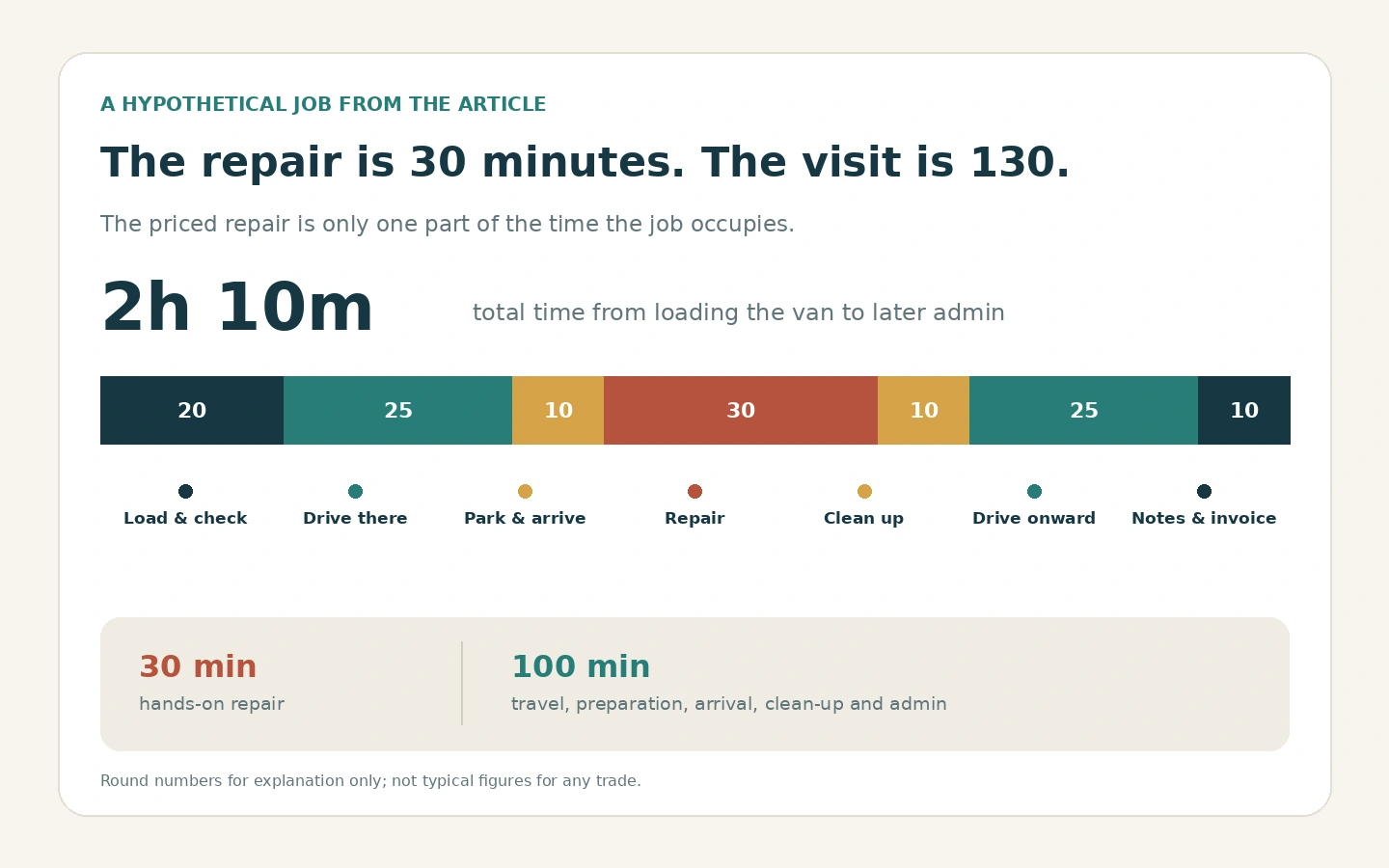
You charge $35 for a half-hour repair. It sounds sensible. Thirty minutes of work, priced a little above what you'd expect an hour to be worth on a quieter day.
Now count the time properly:
- 20 minutes loading the van and checking you have the right parts
- 25 minutes driving there
- 10 minutes parking, unloading and chatting at the door
- 30 minutes of actual work
- 10 minutes cleaning up and talking through what you did
- 25 minutes driving to the next place
- 10 minutes of notes and invoicing later
That is two hours and ten minutes for a job you priced as thirty minutes. If your day is full of jobs like this, you are not running a business with a few cheap jobs in it. You are running a business that pays you for about a quarter of its hours.
Nobody planned this. It happens because the work feels small, so the price feels small, and the other ninety minutes never make it onto the invoice.
Meet the show-up cost: the number hiding inside every visit
Every visit has a cost that has nothing to do with what you do when you arrive. Call it the show-up cost. It is everything that has to happen before the first minute of useful work and after the last one.
It is made of five things:
- Travel time, both ways, valued at what your time is worth rather than what the fuel cost.
- Vehicle cost, which means fuel, wear and the share of your insurance and running costs for that stretch of road.
- Set-up and pack-down, which is loading, unloading, protecting floors and clearing up.
- Admin around the job, meaning the quote, the booking, the notes and the invoice.
- The gap it leaves in your diary, because a job in the middle of the afternoon often makes the hour before and after it harder to use.
The surprise is how little of this changes with the size of the job. Driving to a $40 repair costs the same as driving to a $400 install. On the big job, the show-up cost disappears into the total, so nobody notices it. On the small job it is most of the price.
That is why small jobs feel so tiring for so little reward. It is not your imagination. Most of what you are doing is showing up.
Work out your own minimum call out charge in four steps
You don't need software for this. You need a pen, ten minutes and honest numbers. Here is the method, using the same hypothetical figures.
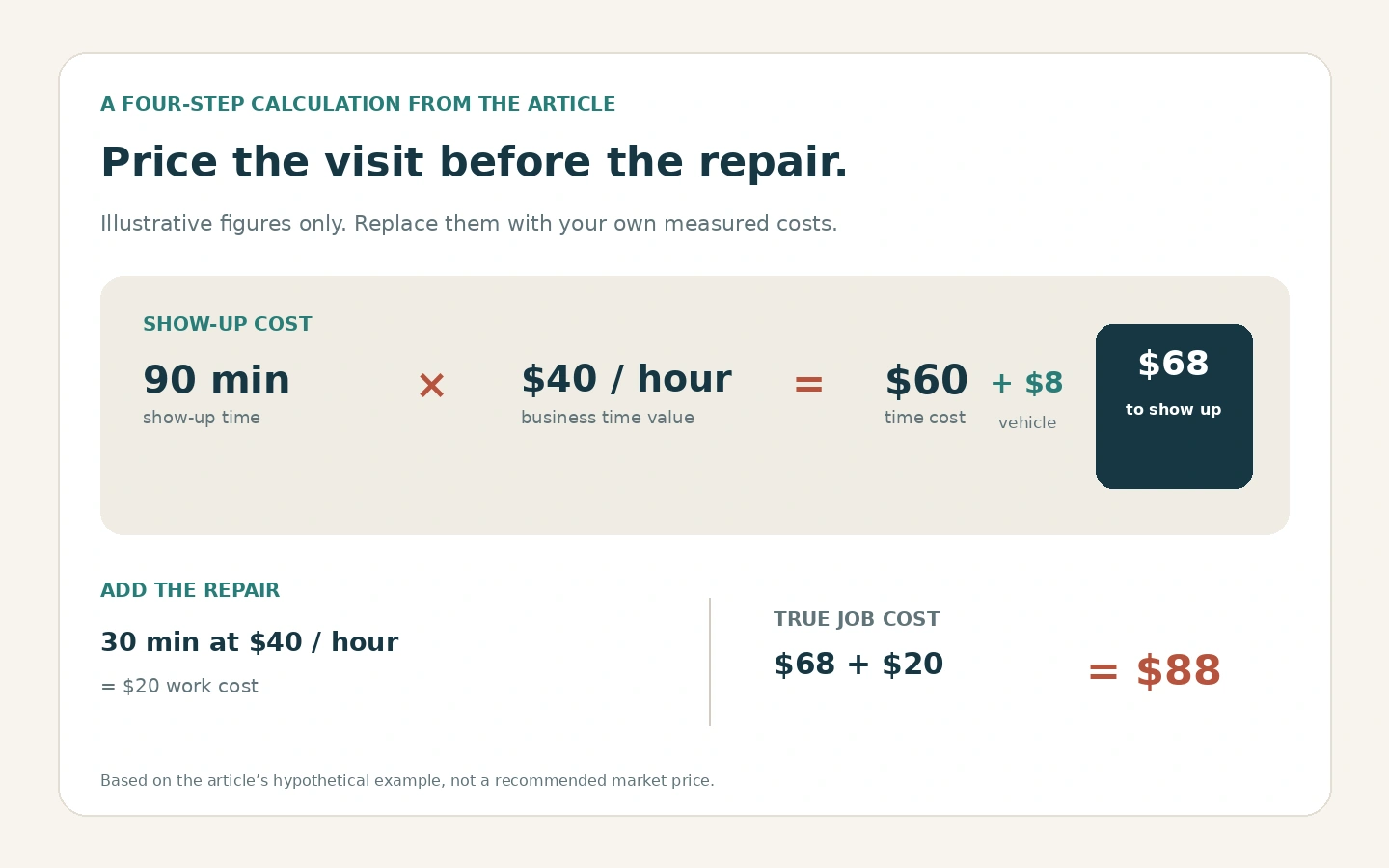
Step 1: decide what an hour of your time costs the business.
This is not your charge-out rate. It is the amount you need each working hour to bring in so that the business covers your wages, tools, insurance, van and a bit left over. If you haven't worked this out yet, our guide to working out your hourly rate is a good place to start. For this example, say it is $40 an hour.
Step 2: measure your typical show-up time.
Look at your last ten small jobs. For each one, estimate the time spent that was not the work itself: loading, driving, parking, tidying, admin. Add them up and divide by ten. If the answer is ninety minutes, that is your average show-up time.
Step 3: add the vehicle cost.
Estimate the mileage for a typical visit and use a rough per-mile figure for fuel and wear. Keep it simple and slightly generous. For this example, say the vehicle cost is $8 for a typical round trip.
Step 4: put it together.
Ninety minutes of show-up time at $40 an hour is $60. Add $8 for the vehicle. That is $68 before you have lifted a single tool.
So the honest cost of showing up to this job is $68. If the customer's repair takes thirty minutes, the true cost is $68 plus $20 for the work itself, which is $88.
Now the $35 quote looks different. It was never going to work. It wasn't a bad price for the repair, it was a price that left out the part of the job that took most of the time.
A minimum charge and a call-out fee are not the same thing
People use these two terms as if they mean the same, and they don't. The difference matters because customers react to them differently.
A call-out fee is a separate charge for coming out, added to the cost of the work. The customer sees two lines: the visit and the job. It is easy to explain and it is common in emergency work, but it can feel like a penalty, and customers often compare it with other businesses who don't list one.
A minimum charge is the lowest total you will accept for any visit. It usually includes the first block of time, perhaps the first hour. If the job takes twenty minutes, the customer still pays the minimum. If it takes ninety minutes, the minimum is replaced by the normal time-based charge.
Here is why this matters. A call-out fee tells the customer they are paying for your drive. A minimum charge tells them they are paying for the first hour of your time, and they get the work for it. The second feels like a product. The first feels like a toll.
Neither is right for everyone. A few things help you choose:
- If most of your work is emergency, separate call-out fees are well understood and accepted.
- If most of your work is planned and small, a minimum charge usually feels fairer.
- If you work in a small area and your drives are short, you may not need either, but you still need a minimum.
Whichever you pick, write it down in one sentence so you can say the same thing every time.
The one sentence that makes the number easy to say
Most tradespeople who hesitate to charge a minimum are not worried about the sums. They are worried about the phone call. What do I say when they gasp?
The trick is to say it before they can react, in a calm, matter-of-fact tone, as a description rather than a request. Here are three versions you can adapt:
"Our minimum visit is $X, and that covers the first hour on site, so if it takes less, you've still got it done properly."
"Because we keep time free in the diary for your visit, there's a minimum charge of $X. If the work runs longer, we'd only charge for the extra time."
"For small jobs, the charge is $X, which includes travel and the first hour. If it turns out to be bigger, I'll tell you before I carry on."
Notice what these have in common. They state the number once. They say what it includes. They offer a way out of the awkward feeling, which is the promise that you will tell them if it gets bigger.
What they don't do is apologise. If you start with "I'm really sorry, but," the customer hears that it's negotiable. Say it as plainly as you'd say the opening hours.
What to say when they tell you the other guy doesn't charge it
This is the moment most people dread, so it helps to have an answer ready.
The other guy might not charge a minimum. He might also be quoting low and making it up with extras, turning up late, cutting the job short or not coming back for the callback. You don't know, and you don't need to guess.
A calm answer is: "That's fair, everyone prices differently. Ours covers the time to get to you and do it properly, so you're not paying for a rushed job. If that doesn't suit this time, I understand."
Then stop talking.
Some customers will leave. Let them. A customer who won't pay a fair price for a small job is rarely the one who becomes a good regular.
Some customers will stay, and many will say "that's fine" before you've finished the sentence. The ones who stay tend to pay promptly and not argue, because they have chosen you on the basis of knowing the price.
There is also a quiet benefit. If you say the number confidently, the customer reads it as a sign that you run a proper business, and that affects how they treat the rest of the job.
The aha: your show-up cost isn't the same on every day
Here is the idea most pricing advice misses.
Everything above treats the show-up cost as a fixed number. It isn't. It is the cost of one particular trip on one particular day, and it can be very different depending on what else is happening around it.
Imagine two customers, both with a thirty-minute job.
Customer A is on the other side of town, and you have nothing booked nearby. The show-up cost is the full ninety minutes plus the vehicle cost.
Customer B is three streets from a job you are already doing that morning. You don't need to reload, you don't need to drive far, and you can finish both jobs inside the same trip. The real show-up cost for Customer B might be twenty minutes.
If you charge both the same minimum, one of them is paying for a cost you don't have. If you set the minimum for Customer A, Customer B is subsidising it. If you set the minimum for Customer B, you lose money on Customer A.
Two things follow from this.
First, you can offer a lower minimum when a job is genuinely close to another booking. It is not a favour. It reflects a real saving, and customers who live nearby will notice and tell their neighbours.
Second, your minimum might be better set in zones. A simple version has three areas: close, middle and far. The minimum rises a little with each. Customers don't mind this, because it matches how they see distance. You can also set a limit beyond which you don't take small jobs at all.
This is the point where the idea of a flat minimum starts to look crude. The smarter version of it is a minimum that depends on where you already are.
Where a minimum charge goes wrong
A minimum charge is simple, and a few simple mistakes can make it unhelpful. Watch for these.
Setting it too low to feel safe. If you pick a number that makes you comfortable on the phone rather than one that matches your show-up cost, you've done the hard part and then undone it. Work from the sum, not from your nerves.
Never revisiting it. Fuel, insurance and your own costs change. Look at the number again once a year, or whenever you notice that small jobs still feel like a drag.
Stacking it on top of everything. If the job turns out to be bigger, the minimum should disappear into the normal charge. Customers get annoyed when they see a minimum, a call-out and a time-based rate all on one invoice.
Charging it on repeat visits for the same job. If you need to come back to finish something that was part of the original job, the minimum shouldn't apply again. That's part of the same piece of work.
Not telling people early enough. A minimum is easy to accept at the booking stage and hard to accept at the door. Say it when you take the call, and put it in the confirmation message.
Forgetting small jobs add up. One small job at a loss is not a problem. A diary full of them is the reason some businesses are always busy and never better off. Our job costing guide shows how to spot it by looking at your last five finished jobs.
Getting the minimum into your quotes and software so you never argue it
A charge you have to remember is a charge you will forget. The best way to make a minimum charge stick is to build it into the places where prices are created.
If you use job software, add the minimum as a standard line item in your price list, so it appears on a quote when you pick it, rather than being typed from memory. If you use a spreadsheet or paper pad, print the line on the quote template.
You can also set up simple rules for yourself:
- If the job is under an hour, use the minimum.
- If the job is over an hour, use the time-based charge and drop the minimum.
- If the job is within the nearby zone, use the nearby minimum.
When the same rule is applied every time, customers see consistency, and consistency is what makes a price feel fair. It also stops you giving away the minimum to the friendly customer and enforcing it with the awkward one, which is how most people end up with a price list that only works on days they feel confident.
If you are choosing software to help with this, look for the ability to save standard items with fixed prices and to add them to a quote in one tap. Our guide to writing quotes that win more trade jobs covers how a price list speeds up the quote itself.
A one-week experiment to find out whether your number is right
Don't set the number and hope. Test it.
For one week, keep a note of every small job. For each, write down:
- What you charged.
- How long the whole thing took, from leaving the yard to finishing the notes.
- Whether the customer said anything about the price.
At the end of the week, divide what you earned from small jobs by the total hours they took. Compare that figure with the hourly figure you worked out in step 1 of the method above.
If the number is lower, your minimum is too low or your show-up time is longer than you thought. If it is the same or higher, you are in good shape.
You may find that one or two job types are always the worst. Maybe it is the far-flung customer, or the job that always needs a second trip because you didn't have the part. These are the patterns worth fixing, and they are far easier to fix when you can see them on paper.
Finally, notice how people reacted. If nobody blinked, you might have room to go a little higher. If two or three complained, the explanation might need to be clearer before the number changes.
What people ask when the minimum charge comes up
Is it fair to charge a minimum for a job that takes ten minutes?
Yes, if the ten minutes is only the visible part. The customer is paying for a trained person to be available, travel to them and fix the problem, not for the minutes on the clock. A mechanic's quick check and a doctor's short appointment follow the same logic.
Should I charge VAT or sales tax on top?
That depends on your registration and where you work. Check with your accountant or the official guidance for your country, because the rules differ and change. The point here is that whatever you quote, you should say clearly whether it includes tax.
What if a customer thinks the minimum is unfair?
Explain it once, clearly, and offer to include something extra, such as checking one more small thing while you are there. This often resolves it, because the customer feels they are getting something rather than just paying something.
Can I waive the minimum for regulars?
You can, but decide the rule in advance. A regular who books several jobs a year might get the nearby rate, or you might offer a small bundle of "while I'm here" tasks. Waiving it on the spur of the moment teaches everyone to ask.
Do I need to put it in writing?
Yes. Put it in the booking confirmation, on the quote and on the invoice. It is much easier to explain a charge the customer has already seen.
Your next step: five small jobs and a calculator
A minimum call out charge isn't about squeezing customers. It is about telling the truth about what a visit costs.
Every visit has a show-up cost that doesn't shrink when the job does. Work out yours, set a minimum that covers it, say it calmly before the customer can react, and adjust it for jobs that are close to other bookings.
Your next step is small. Take your last five small jobs, add up the real time each one took, and compare it with what you charged. You will either find that your numbers are fine, or you will find the reason some of your busiest weeks feel the poorest. Either answer is worth having.
When you are ready to go further, our guide to choosing simple field-service software shows how to test whether a tool makes quoting and pricing small jobs faster.