
Cleaning & landscaping software
How to Choose Software for Cleaning or Landscaping Businesses
Choose tools for repeat visits, changing crews, seasonal routes and one-off landscaping projects without overlooking split-system costs.
 13 min read

A cleaning route and a landscaping route can both repeat every week, but they do not repeat in the same way. A house clean may need the same access notes, crew preferences and checklist each visit. A lawn-maintenance contract may shift with weather, season and site conditions, while the same company also quotes one-off planting or hardscape projects.
For a business that does both, the deciding question is not which product has the most recurring-job features. It is whether one system can keep the repeat schedule reliable without making estimates, exceptions and field updates awkward.
Short answer
- Start with Jobber if one small company needs recurring cleaning or maintenance visits alongside quoted, one-off landscaping jobs in a broader quote-to-payment workflow.
- Compare Housecall Pro if scheduling, dispatch, customer updates, estimates and payment collection matter across both cleaning and lawn-care work.
- Choose ZenMaid when residential cleaning is the main business and the landscaping work is occasional, rather than the other way round.
- Consider Connecteam when staff scheduling, timekeeping, checklists and team communication are the main gaps, and a separate customer quoting and billing system is acceptable.
- Consider Swept when commercial cleaning across multiple sites is a major operation of its own. It is not a substitute for testing how landscaping estimates and project billing will work.
Before comparing plans, list the services that repeat, the work that changes each visit, and the one-off jobs that need a quote. Then test those exact cases in the same product. A platform can advertise recurring appointments yet still leave you rebuilding the crew instructions or repairing the invoice after a weather change.
One business, two different kinds of repeat work
Residential cleaning tends to repeat around a customer and property. The schedule might be weekly or fortnightly, but the operational details are stable: access, rooms, preferences, assigned cleaners, arrival messages and the expected service checklist. A skipped clean or a substitute cleaner should not accidentally alter the next visit in the series.
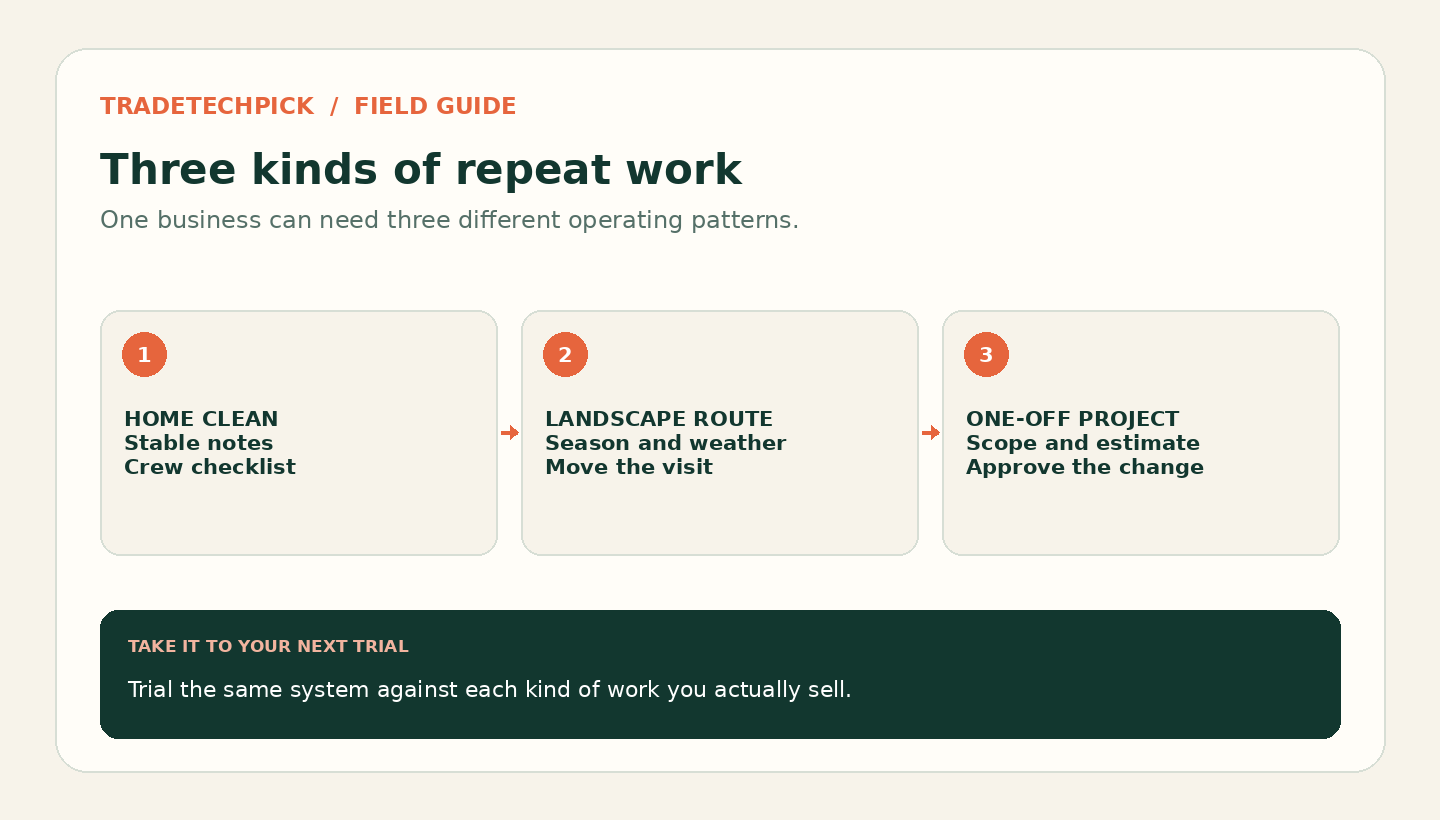
Landscaping maintenance can also repeat, but the service may be conditional. Mowing, pruning, seasonal treatments and cleanups have different cadences. Rain, heat, growth and site conditions can move the work. Alongside those planned visits, a landscaper may sell a one-off planting, redesign or repair project that needs its own scope, estimate, materials and approval.
That makes a mixed operator's test more demanding than a standard recurring-job demo. The system needs to preserve the routine work while letting one visit or one project change without corrupting the rest of the schedule.
| Workflow | What must stay consistent | What may change | Test in the software |
|---|---|---|---|
| Recurring home clean | Property notes, access, service checklist and customer cadence | Cleaner assignment, skipped visit, duration or add-on | Change one appointment and confirm the rest of the series remains correct |
| Recurring lawn or garden maintenance | Property, service plan, crew instructions and visit history | Weather date, seasonal task, crew, materials or site condition | Move one visit, preserve future dates and notify the right people |
| One-off landscaping project | Approved scope, estimate, customer decision and job record | Materials, access, stages, schedule and variation | Turn an accepted quote into work without losing the agreed scope |
| Mixed daily route | Address, time window, assigned people and job status | Travel order, cancellation, delay and urgent insert | Reorder the day and see whether field staff receive the change |
Best starting point for mixed recurring and quoted work: Jobber
Jobber's recurring-job documentation describes repeating visits on weekly, biweekly, monthly or custom schedules, with separate choices for how a recurring job is invoiced. Its landscaping information also describes recurring work, one-off projects and rescheduling when weather or cancellations change the day. That combination makes it a sensible first product to test when cleaning and landscaping share a small office, customer list and field team.
The important question is how well the details survive the transition from a standing service to an exception. Test a weekly clean with property instructions, a seasonal lawn visit, a rain delay and a separately quoted planting job. Check whether the crew can distinguish the work and whether a price change on one visit stays local to that visit.
Jobber may be less suitable if the cleaning side depends on specialist maid-service booking logic or if commercial clients require detailed site inspections and location-level proof. Broad field-service coverage does not automatically mean every cleaning workflow is native to the product.
Check Jobber's current plan and pricing information
Best alternative when dispatch and customer payments matter: Housecall Pro
Housecall Pro's cleaning information describes recurring weekly, biweekly and monthly jobs. Its lawn-care information describes weekly, biweekly and seasonal schedules, crew assignment, route planning and changes when weather or customer requests shift the day. Its service workflow also covers online booking, estimates, scheduling and payment collection.
For a mixed operator, compare the customer and job records rather than just the calendar. Can the office tell a routine clean from a seasonal lawn treatment? Can the team quote a landscaping project, record an approved change and invoice it without turning the recurring maintenance contract into a one-off job? Run both through a trial using the same staff and real devices.
Housecall Pro is worth shortlisting when the company wants a broad home-service operating system. Confirm which features are included in the plan you would actually buy, and whether the tools for a commercial cleaning contract or a staged landscape project meet your requirements.
Check Housecall Pro's current plan and pricing information
When cleaning is the core business: ZenMaid
ZenMaid focuses on residential maid services. Its public product information emphasizes cleaning schedules, dispatch, customer and cleaner communication, online booking, and cleaning-specific appointment workflows. That focus can be useful when most revenue comes from repeat home cleans and the landscaping work is limited.
The trade-off is not that a specialist product is automatically too narrow. It is that the business may need a second system for estimates, project scope or landscaping work. Before adopting two tools, decide which one owns the customer record, schedule changes, payment status and service history. If the same client appears in both, assign a clear source of truth.
Check ZenMaid's current plans and appointment limits
When workforce coordination is the main pain: Connecteam
Connecteam's cleaning and lawn-care pages describe employee scheduling, job details, checklists, time tracking and team communication. Those tools can help when crews need clear instructions across several job sites and the business already has a separate platform for customer estimates and billing.
Do not treat an employee schedule as a complete service-business workflow. Test how a new customer request becomes a quoted job, how a completed visit becomes an invoice, and how changes reach the customer. If that chain lives in another product, include the time and risk of maintaining both.
Check Connecteam's current hub and team pricing
When commercial cleaning needs its own operating controls: Swept
Swept positions its product around commercial cleaning and janitorial operations, including recurring schedules, employee time, site instructions, inspections and location-level communication. This can fit a mixed company whose commercial cleaning contracts have distinct quality and attendance requirements.
It should not be selected as the single platform for a mixed cleaning-and-landscaping company until the landscaping side has been tested. Confirm where estimates, one-off projects, customer billing and maintenance routes would live. A specialist cleaning operations tool may complement a field-service system, but a two-system design needs explicit ownership of shared customers and payments.
Check Swept's current plan and location bands
A practical five-scenario comparison
Use the same five scenarios in each finalist. Do not let one vendor demo a clean recurring visit while another is tested on a complicated project.
- Routine clean: create a repeating home clean with access notes, checklist, customer messages and a preferred crew.
- Weather move: delay one lawn visit, change the route and confirm future maintenance dates stay intact.
- One-off project: quote a planting or garden refresh job, record an approval and keep the scope available to the crew.
- Staff change: replace an unavailable cleaner or landscaper and verify the right instructions follow the new assignment.
- Closeout: complete work, attach any required checklist or photos, invoice the correct customer and confirm the payment status.
Score each step as complete in the product, possible with a workaround, or dependent on another tool. Also record how many times the office re-enters information. A low monthly subscription can become an expensive workflow if every route change needs manual repair.
Questions to answer before choosing
Which service line is the software meant to fit first?
Choose the product around the work that creates most of the recurring administration. Do not expect a maid-service specialist and a broad landscaping platform to have identical strengths.
Can one visit change without rewriting the whole series?
Test skipping, rescheduling and repricing one appointment. Confirm what happens to future visits, saved instructions and invoices.
Can the same team distinguish different kinds of work?
Use separate service names, durations, checklists and job notes for cleaning, maintenance and projects. A crew should not have to infer which version of the customer's instructions applies.
What happens when you need two systems?
If specialist cleaning software handles recurring homes while a field-service product handles landscaping, decide which system owns customers, changes, invoices and reporting. Estimate the extra reconciliation before committing.
Bottom line
For a small business combining recurring cleaning with mixed landscaping work, start by testing Jobber and Housecall Pro against both a stable repeat service and a weather-shifted, quoted project. Their broader field-service workflows are the more natural first comparison for a shared operation.
Choose ZenMaid when residential cleaning is the clear centre of the business and its specialist schedule outweighs the need to manage landscaping in the same system. Add Connecteam to the shortlist when workforce visibility is the problem, and Swept when commercial cleaning inspections and multi-site shifts are central.
For a residential-cleaning-only shortlist, see our cleaning business software guide. For a small business software selection framework across field-service work, start with our small-business field-service software guide.
The deciding test is simple: move one recurring visit, change one crew, quote one project and close one invoice. Pick the system that keeps the routine dependable without hiding the exceptions.