
Costs & Pricing
How to Build a Price Book for a Small Trade Business in One Weekend
Quoting from scratch every time is slow, and it's why prices drift. How to build a price book for a trade business from your own past jobs, in one weekend.
 14 min read

If you want to build a price book, the good news is that most of it already exists in your head and your past invoices.
Ask three tradespeople how they price a job and you'll hear three different answers. One says, "It depends." One says, "I go by feel." One says, "Based on what they look like they can afford," usually followed by a laugh.
All three are describing the same thing: a price created fresh each time, inside the head of the person quoting. It works, in the sense that jobs get done and invoices go out. But it has a cost. It's slow. It's inconsistent. And it drifts, quietly, until the price you charge for a job in June bears little resemblance to what you charged in January.
A price book fixes that. This guide shows how to build a price book for a trade business from your own history, over a single weekend, without any special software. You'll see what goes in it, how to decide the prices, the sneaky reason most price books fail within a month, and the way to keep yours honest as costs change.
What a price book is, in plain words
A price book is a list of the things you sell, each with a price.
That's all. It might be a page in a notebook. It might be a spreadsheet. It might sit inside job software. The form matters less than the idea: you decide the price once, in a calm moment, and then reuse it.
The things on the list are usually of three kinds.
Tasks. Whole jobs that you do regularly. "Replace a mixer tap." "Fit a socket." "Service a boiler."
Time. Your hourly or half-day rates, for work that doesn't fit a standard task.
Materials and parts. The items you buy and resell, with your standard markup.
Together, these let you build most quotes by picking items and adjusting quantities, rather than working things out from nothing.
You may have heard the term "flat-rate pricing". That simply means charging a fixed price for a defined task, regardless of how long it takes on the day. A price book is the tool that makes flat-rate pricing possible.
What goes wrong when every price is invented on the day
Before building something, it helps to see what it replaces.
You quote differently depending on your mood. After a good week you might feel generous. After a rough one you might push the price up. Customers don't see the reasons, only the result.
You forget costs. Without a list, it's easy to leave out the parking, the disposal, the second visit.
You're slow. Working out a price while the customer stands there is stressful, and the pause feels awkward. A quote that takes a day to send loses to one that arrives in an hour.
You can't hand over quoting. If a helper or admin person needs to give a price, they have nothing to go on.
You can't learn. If every price is new, you can't compare what you quoted against what a job cost. Our job costing guide shows why that comparison matters.
Prices drift. Costs rise slowly. If you don't revisit your numbers, you drift into charging less in real terms without noticing.
A price book doesn't solve all of this at once, but it addresses every one of them.
Step one: mine your own history for the jobs you actually do
You don't need to invent a price book from nothing. Your past work already contains it.
Spend an hour looking through your last two or three months of invoices, quotes, messages and notes. You are looking for patterns.
Make a list of every type of job you did. Don't worry about prices yet. Just write names.
"Replace kitchen tap." "Unblock sink." "Fit outside tap." "Service boiler." "Fit smoke alarm."
Then count how many times each appeared. You'll probably notice that a handful of jobs account for a large share of your work. That's your core list.
Pick the top twenty. If you offer a wide range of services, you might choose ten for each main area. Don't try to price everything. Starting with the twenty most common tasks covers a surprising share of your quotes.
You may also spot jobs you do often that you hadn't thought of as a standard task. A routine "while you're here" request, a small repair you do again and again. These are good candidates, because standardising them saves the most time.
Our guide to handling job variations and extras suggests listing your most common extras too, so you can price them quickly on site.
Step two: find out what each job really costs you
For each job on the list, work out what it actually costs to do. You need three numbers: the time, the materials and the show-up cost.
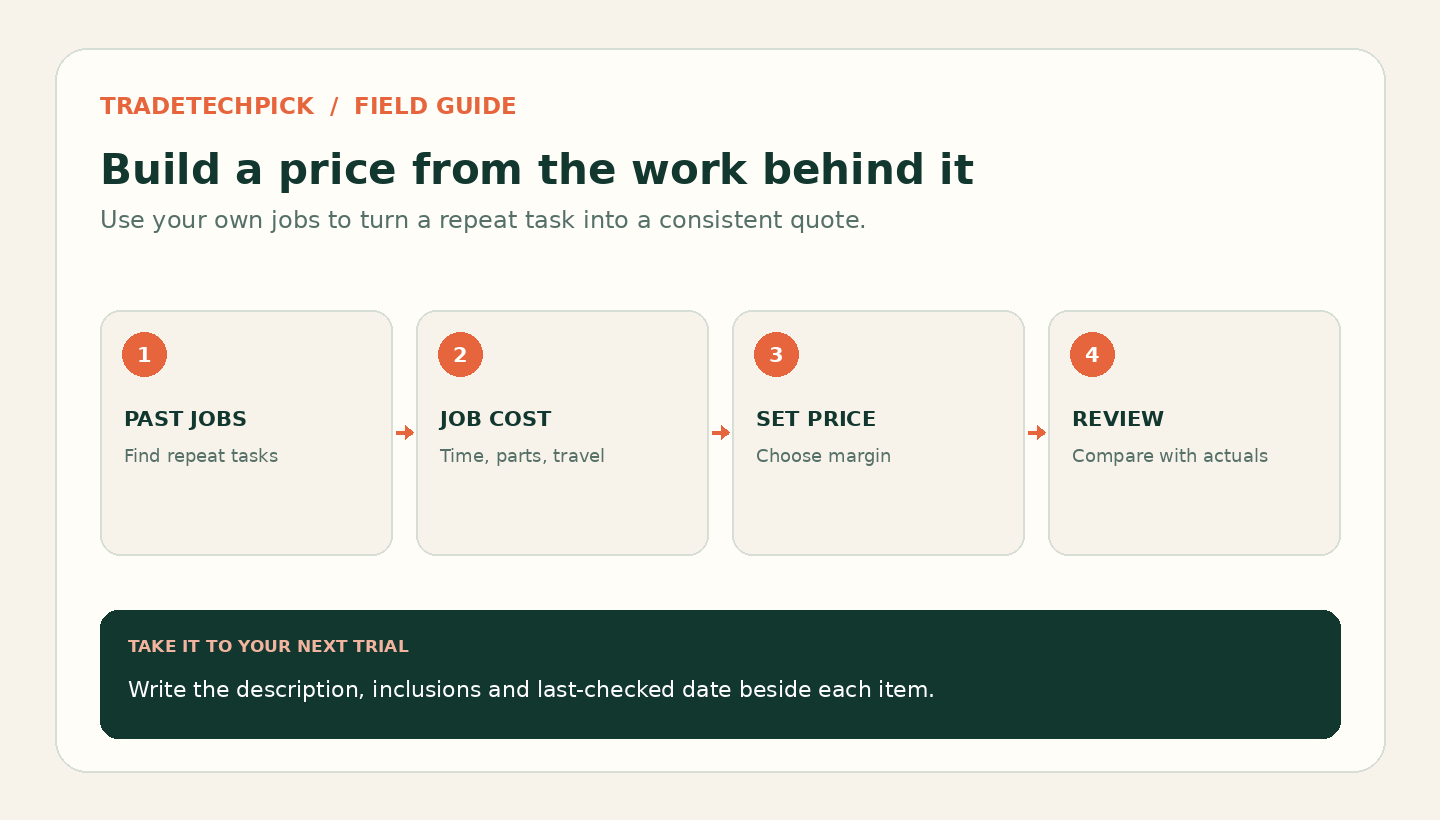
Time. How long does this job usually take? Look at past jobs, or estimate honestly. If it varies, note the typical range and use a sensible middle.
Materials. What parts and consumables go into it? Write the cost to you, not the retail price.
Show-up cost. The travel, set-up and admin around the job. This is the hidden cost we explain in our guide to the minimum call out charge.
Here's a hypothetical example, with round numbers chosen only to show the arithmetic.
Replacing a kitchen mixer tap:
- Time on site: 1 hour
- Tap and fittings bought by you: $60
- Show-up cost: $50
If your internal cost of an hour of work is $40, the total cost to you is $40 plus $60 plus $50, which is $150.
Notice that the tap, the thing the customer can see, is a minor part of the cost. Most of the cost is your time and the effort of getting there.
Do this for each job on your list. It takes a while the first time, and many people find it surprising. Some jobs turn out to be cheaper to do than they assumed. Others turn out to be money-losers.
Step three: add your margin and decide the price
Once you know the cost, you decide what to charge.
The difference between cost and price is your margin. It's what pays for everything the business needs beyond the job: your profit, your growth, your bad weeks.
There's no universal margin that suits every trade. It depends on your market, your competition and what customers are willing to pay. What matters is that you choose it deliberately, not by accident.
Let's carry on with the example. The tap job costs you $150. If you'd like a margin of a third on the price, you'd charge $225. If you'd like a smaller margin, you'd charge less.
Before settling, do a sense-check.
Does it feel reasonable for the customer? Ask yourself whether a customer would see the price as fair. If it feels very high, check your costs. If it feels low, check whether you've left something out.
How does it compare locally? You don't need to match competitors, but you should know roughly where you sit. Ask a few friendly colleagues, or look at published prices.
Does it respect your minimum? A very small job should never fall below your minimum charge.
If a price makes you uneasy, don't just lower it. Ask why. Sometimes the right answer is a different way of doing the job, such as using a cheaper but still suitable part. Sometimes it's the courage to charge more.
Step four: set your materials markup and stick to it
Materials are a common source of confusion. Should you charge cost, or cost plus something?
Most businesses add a markup to materials. That isn't greed. It covers the time spent finding, buying, collecting and storing parts, the risk of getting things wrong, and the warranty you stand behind.
If you charge materials at cost, those jobs aren't free for you. You are doing the sourcing for nothing.
Pick a markup rule you can explain in one sentence. Some businesses use a flat percentage. Others use tiers, with a higher percentage for small items and a lower one for expensive items.
The important thing is consistency. Apply the same rule every time, and make sure it's reflected in your price book.
Our guide to marking up materials fairly goes into how to choose a figure and explain it to customers without awkwardness.
If your materials prices change frequently, note the date you last checked. Suppliers' prices move, and a price book with last year's costs will quietly shrink your margin.
Step five: write each item so a customer would understand it
Now turn your list into something you can show people.
Each item needs a name and a short description. Write them for the customer, not for you.
"Replace kitchen mixer tap" is better than "Tap swap job type A".
A good description says what's included. "Supply and fit one mixer tap, remove old tap, test for leaks. Customer-supplied taps can be fitted at a reduced price." It also hints at what isn't.
Descriptions do three things.
They make quotes clearer. The customer reads exactly what they're getting.
They reduce arguments. If an item is described well, there is less room for "I thought that was included".
They help you remember. Six months later, you'll know what the item meant.
Add notes for yourself too. "Allow extra time in older properties." "Check access before quoting." These can sit in the book and prompt you at the right moment.
The reason most price books fail within a month
Here's the part nobody warns you about.
Most price books don't fail because the prices are wrong. They fail because they're awkward to use.
You build a beautiful spreadsheet. You feel proud. Then, a week later, a customer rings and you're in the van. You can't open the spreadsheet on your phone easily. You can't remember where you saved it. So you quote from your head, as you always did.
Within a month, the book is a museum piece.
The fix is to make the price book as easy to reach as your phone's calculator. Ask yourself where you'll be when you need it:
- On site, with the customer watching.
- In the van, between jobs.
- At home, in the evening.
- On the phone, in the middle of a call.
Then make sure the book is readable in every one of those places. That might mean a note on your phone, a printed card in the van, or a list in your job software.
If you're considering software, look for the ability to save standard items with prices and descriptions, and to add them to a quote quickly. Features and plans vary between products, so test it with a real quote on your own phone. Our guide to writing quotes that win more trade jobs shows how a price book speeds up the process.
Simplicity is the key. A short book you use is worth more than a long one you don't.
Keeping your price book honest as the year goes on
A price book isn't a one-time project. It needs a little attention to stay accurate.
Review it every few months. Set a recurring reminder. Check a handful of items against your recent costs.
Check against real jobs. Occasionally compare what you quoted with what a job cost. If you find a gap, adjust the item.
Watch supplier prices. If parts get more expensive, update the book promptly.
Add new items. When you notice that a job keeps coming up, add it.
Retire old items. Remove tasks you no longer offer.
Date it. Put a "last updated" date on the book. It reminds you, and anyone else using it, how fresh it is.
An annual price rise is also easier when you have a book. You can adjust items by a consistent amount rather than agonising over each quote. Our guide on raising your prices without losing your best customers shows how to introduce changes gracefully.
Common mistakes when building a price book
Before you start, here are some traps to avoid.
Trying to price everything. Start with twenty items. Add more later.
Copying a competitor's prices. Their costs aren't yours. Build from your own numbers.
Forgetting the show-up cost. It's the most commonly omitted item and the biggest cause of underpricing.
Making it too complicated. If you need a manual to use the book, it won't get used.
Never updating it. An out-of-date book is worse than none, because it gives false confidence.
Hiding it from your team. If you have helpers, share it so everyone quotes consistently.
None of these is hard to avoid once you know about it.
Pricing a job you have never done before
A price book is built from the jobs you know. But sooner or later someone asks for something you have never priced. What then?
Break it into pieces you already understand. Almost every new job is a combination of old ones. A bathroom light with a new fan, for example, is a light fitting you have priced before, plus a fan installation you have priced before, plus a small amount of extra time for working around the two.
Price each piece from your book. Then add a margin of time for the unknown, based on how unfamiliar the work feels. If you have done something very similar, add a little. If it is genuinely new, add more, and say in the quote that the price is based on assumptions.
After the job, record what really happened. How long did it take? What did it cost? Then add it to the book as a proper item. A job you priced nervously this month is a confident line in your book next month.
This habit has a second benefit. Over a year, your price book grows from your actual work rather than from guesses, and it reflects what your customers really ask for.
If a new job is much bigger than anything in the book, do not stretch the book to cover it. Quote it as a project, with a visit if necessary, and use the book for the pieces inside it.
Price book questions from people who have just started one
Do I need software for a price book?
No. A notebook, spreadsheet or phone note works for a small business. Software can make it faster to use, but only if you will actually use it.
Should I show customers my price book?
You can, but you don't have to. Many businesses show the price for the specific job without revealing the whole list.
What if a job doesn't fit a standard item?
Use your time rate plus materials, and consider adding a new item if it recurs.
How do I handle different customers, such as landlords and homeowners?
Some businesses have the same book with different terms. Others have separate pricing for commercial work. Decide on a rule and apply it consistently.
Is flat-rate pricing fair to customers?
When prices are clear and based on real costs, many customers prefer it, because they know what they'll pay before you start.
An hour this weekend to price your first three jobs
A price book replaces guesswork with a list you've thought about carefully. Start with your twenty most common jobs. Work out the true cost of each, including the show-up cost. Choose a margin and a materials markup. Describe each item clearly, and keep the book somewhere you can reach it in seconds.
This weekend, spend an hour looking back through your recent jobs and list the ten you do most. Price three of them properly. Next week, use those three on real quotes. Notice how much faster and calmer quoting feels.
In a month, you'll have a tool that quietly protects your margins every day.