
Software Basics
How to Get Google Reviews as a Tradesperson Without Feeling Pushy
Happy customers rarely write reviews on their own. When to ask, what to say, and how to get Google reviews as a tradesperson without feeling pushy.
 12 min read

Most happy customers never write a review unless someone asks, and knowing how to get Google reviews as a tradesperson without feeling pushy comes down to timing.
Think of the last five customers who were really pleased with your work. The ones who shook your hand, said "brilliant", and told you they'd call you again.
How many of them left a review?
If the answer is none, or one, you're in good company. Happy customers are busy. They mean to write something, they forget, and a week later it's too late. The glowing review you deserved never gets written, and the next person searching for someone like you sees a thin page and calls a competitor instead.
This guide is about how to get Google reviews as a tradesperson in a way that feels natural rather than pushy. It covers why timing matters more than wording, how to ask in person and by message, what to do about a bad review, and an idea about review requests that has nothing to do with asking for a review at all.
Why the review you deserve rarely gets written
Reviews feel like they should happen on their own. You do a good job, the customer is grateful, and somewhere between the handshake and the front door, they decide to tell the world.
In reality, that almost never happens. There are a few quiet reasons.
Writing takes effort. A review means opening an app, finding your business, choosing a star rating and typing a few sentences. For someone with a to-do list and a family, that's a chore.
There's no trigger. The moment of gratitude passes, and nothing prompts them to act on it.
People assume you don't need them. Some customers think reviews are for big companies. They have no idea how much a handful of reviews matters to a small trader.
Unhappy people feel more urgency. Someone who has had a bad experience is often motivated to speak up. Someone who had a good one is content to move on. This is why many businesses find that unrequested reviews lean negative.
So the question isn't "why don't they like me enough?" It's "what makes writing a review easy and obvious?" That is a problem you can solve.
The three-minute window when customers are most willing to say yes
Timing matters more than words.
There's a short period, usually within a few minutes of finishing the job, when the customer is at their happiest. The problem is solved. The mess is cleaned up. They are looking at the result and feeling relieved.
That is the moment to ask.
Not three days later, when they've half forgotten the details. Not a week later, when they've moved on to the next thing.
Compare how it sounds.
At the door: "I'm glad that's sorted for you. If you were happy with it, a quick review would really help us. I can send you the link now."
Three weeks later, by message: "Hi, we did some work for you a while ago. Would you mind leaving a review?"
The first connects directly to the feeling in the room. The second arrives out of context, and the customer has to remember who you are and why they should care.
So build the ask into the end of the job. Make it part of the routine, like checking you have your tools, rather than an afterthought.
What to say in person, in words that sound like you
Many tradespeople feel awkward asking face to face. The awkwardness usually comes from thinking you are asking for a favour. Try thinking of it differently: you're giving the customer a chance to help someone they were happy with.
Here are some approaches that sound natural.
The simple one. "If you're happy with how it's turned out, it would really help me if you could leave a short review. I'll send you the link."
The small-business one. "Most of my work comes from word of mouth and reviews. If you wouldn't mind leaving one, it makes a big difference to a business my size."
The specific one. "You mentioned the tap's been dripping for months. If you'd say that in a review, it would help other people with the same problem find me."
The handover one. "Here's the invoice, and here's a link to leave a review if you'd like to. No pressure at all."
Notice the pattern. Each one explains why the review matters, makes the request small and offers the link immediately.
What to avoid:
- Asking before the customer has seen the finished work.
- Making it sound like an obligation.
- Offering money or favours in exchange. Platform rules usually forbid this, and it damages trust.
- Hinting at what stars you'd like.
If the customer says "I'll do it later", smile and say, "No problem, I'll send the link so you've got it." Then send it before you leave.
Make the link so easy that saying yes takes ten seconds
The biggest barrier isn't willingness. It's friction.
If you ask for a review and the customer has to search for your business name, scroll past three similar listings and find the right one, many will give up.
The fix is a direct review link. Google lets business owners find a link that takes customers straight to the review box for their listing. Check Google's own help pages for how to find yours, as the steps change from time to time.
Once you have it, make it easy to share:
- Save it on your phone as a text snippet, so you can paste it into a message in seconds.
- Turn it into a QR code and print it on a card, invoice or van sticker. A customer can scan it with a phone camera.
- Add it to your email signature and invoice template.
- Include it in your job-completion message, so it goes out automatically.
Then think about the whole process from the customer's side. They tap the link. It opens in the right place. They tap the stars. They type a sentence or two. That's it. If any step is awkward, fix it.
Test it yourself. Send the link to your own phone and follow it as if you were a customer. You may find a bump you hadn't noticed.
A message you can copy and send straight after the job
Not every customer is at the door when you finish. Some are at work. Some prefer to be left alone. For them, a short message works well.
Here's a template. Change the words so they sound like you.
"Hi [name], thanks again for having us today. Hope you're happy with the [job]. If you were, would you mind leaving a short Google review? It really helps a small business like ours. Here's the link: [link]. Thanks so much, [your name]."
Why does this work?
- It starts with thanks, not a request.
- It mentions the actual job, which makes it personal.
- It includes the link, so there's nothing to search for.
- It's short enough to read in a few seconds.
Send it the same day. If you wait until the following week, response rates drop, because the glow of the finished job has faded.
You can send it by text or email, depending on how you usually communicate. If the customer has been replying to your texts, use that. If they prefer email, use that.
Some job-management tools can send review requests automatically after a job is marked complete. Whether this is available depends on the product and plan, so ask the provider in writing and test the message yourself. If you use a manual process, a saved message on your phone does the job nicely.
The one question that gets better reviews than asking for a review
Here's the idea promised earlier.
Instead of asking, "Would you leave a review?", try asking, "How did we do?"
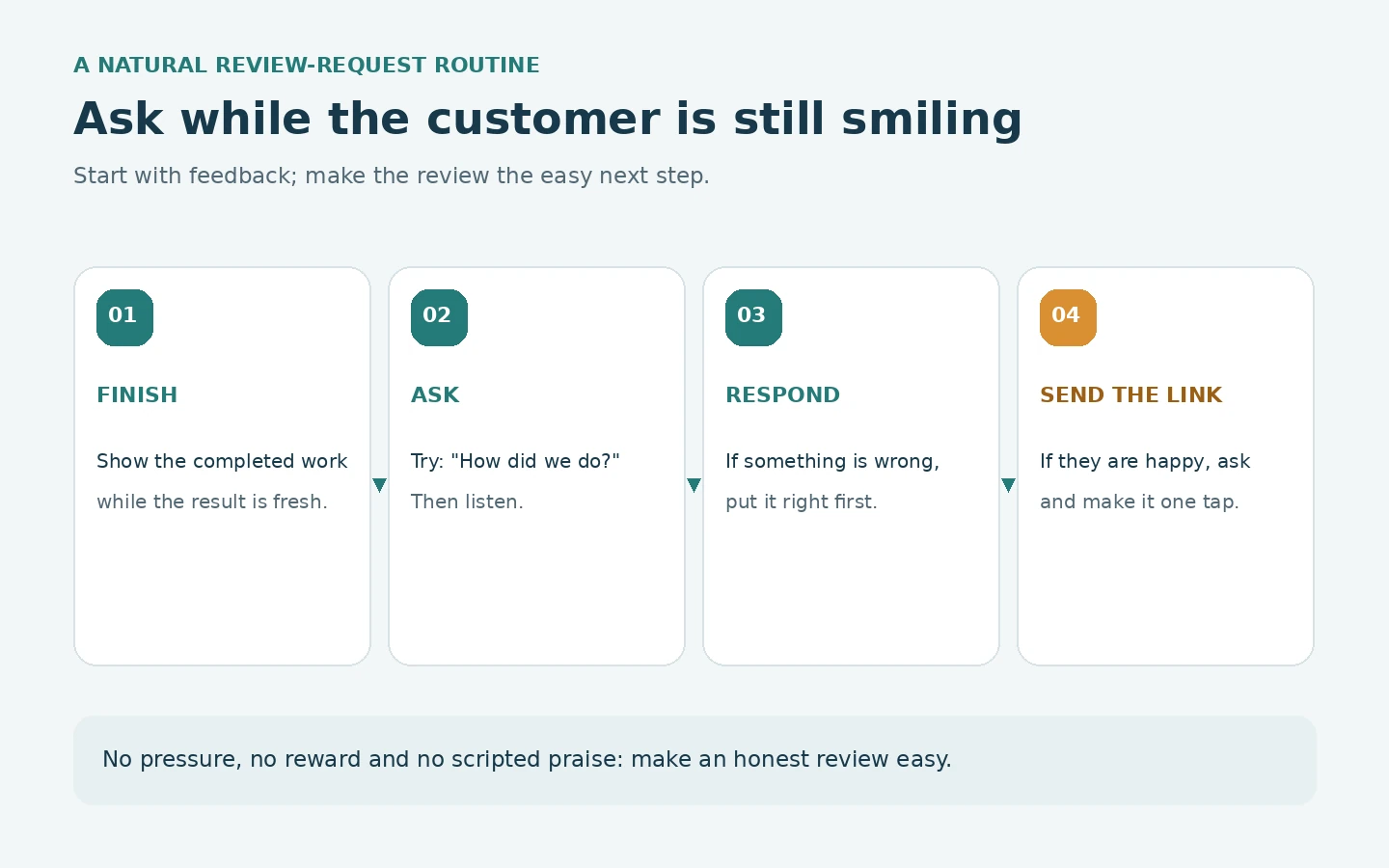
It sounds like a tiny difference, but it changes the conversation.
When you ask someone how you did, you invite them to tell you what they think. They'll often say something lovely: "It's fantastic, you've done a great job, and you were so tidy." At that moment, you have a natural opening: "That's really kind. Would you mind putting that in a quick review? It helps people find us."
Now the review request follows something the customer has already said aloud. They are not being asked to invent an opinion. They are being asked to repeat one.
This also has a second benefit. If the customer isn't happy, you hear about it before they go online. You can fix the problem, or at least show that you care, while there is still time.
That's the real value of the question. It's both a review strategy and an early warning system.
If the answer is mixed, listen. "It's good, but the finish around the edge isn't quite right." Say, "Thanks for telling me. Let me sort that now." Then fix it, and ask again afterwards.
A customer whose problem was solved quickly often becomes your biggest fan, and they tend to write particularly warm reviews.
Getting specific reviews that help the next customer decide
A review that says "Great service, 5 stars" is nice. A review that says "Replaced our boiler thermostat the same afternoon, tidy and explained everything" is far more useful, to future customers and to search engines.
You can't script what customers write, and you shouldn't try. But you can gently encourage detail.
Ask a specific question. "What was the problem when you called us?" The customer's answer often becomes the first line of their review.
Suggest topics, not words. "If you want to mention how quickly we came out or how tidy we left things, that's what people tend to care about."
Make sure they know where they live. A review mentioning the area ("in Cheltenham") can help local customers recognise your coverage. But don't ask people to write particular phrases.
Use the job type in your message. "Thanks for having us fit your bathroom" nudges them to mention the work.
Why does this matter? Because someone reading reviews is trying to answer a question: "Will this person do a good job on my kind of problem?" Specific details answer that question. Generic praise doesn't.
It's also worth thinking about what makes a review believable. A mix of detailed and short ones looks natural. A page of identical five-word reviews can look suspicious.
When a bad review lands, what to do in the first hour
Sooner or later, you'll get a review that stings. It might be unfair. It might be partly fair. Either way, your reaction matters more than the review itself, because future customers will read both.
Here's a calm approach.
Step one: breathe, and don't reply yet. An angry first draft helps no one. Wait until you can write calmly.
Step two: find out what happened. Check your records. Look at the job notes, photos, messages and invoice. What did the customer actually experience?
Step three: try to contact them directly. A quick call or message can sometimes resolve the problem privately. "I saw your review and I'm sorry things weren't right. Could we talk so I can put it right?"
Step four: reply publicly, briefly and kindly. The reply isn't for the reviewer. It's for everyone reading. Something like:
"Thanks for the feedback, and I'm sorry we didn't get this right. I've tried to contact you to sort it out, and my number is [number]. We take this seriously."
Step five: don't argue. Don't list the customer's mistakes. Don't suggest they're lying. Even if you're right, a defensive tone makes you look worse.
Step six: learn from it. Is there a pattern? Maybe expectations weren't clear, or a part of the process is weak. Use the review to fix it.
If a review breaks the platform's rules, for instance if it's abusive or about a different business, you can report it through the platform's own process. But don't count on removal, and don't treat every negative review as a violation.
A single bad review among many good ones is normal. In fact, a profile with only perfect reviews can look odd. What counts is the overall picture, and how you respond.
Reviews are only half the job: let people see you reply
Many tradespeople ask for reviews and then ignore them. That's a missed opportunity.
Replying to reviews, good and bad, tells future customers that you pay attention. It also gives you a chance to show your personality.
For positive reviews, a short, warm reply is enough:
"Thanks, Sam. It was a pleasure working in your kitchen, and I'm glad the new tap is behaving."
Mention something specific from the review. Use their name if it's shown. Keep it brief.
For negative ones, follow the approach above.
A reply doesn't need to be clever. It needs to be human. A customer scanning your profile before deciding whom to call will notice whether you reply, and how.
Set aside a few minutes each week to check and respond. It can be part of your regular routine. Our guide to the 30-minute weekly business review shows how to fit this in without it growing into another chore.
How many reviews are enough, and what to track
Everyone wants a number. How many reviews do I need? The honest answer is that there isn't a magic figure, and it depends on your area and your competitors.
A more useful approach is to think in terms of rhythm and recency.
Rhythm: Aim for a steady trickle rather than a burst. A few new reviews every month looks healthy and active.
Recency: Customers care about recent work. A profile with lots of reviews but nothing in the last year can look dormant.
Coverage: Reviews from different job types help show the range of what you do.
To track this without effort, keep a simple note once a month:
- How many jobs did we finish?
- How many review requests did we send?
- How many reviews did we receive?
- Did any mention something we could improve?
After a few months, you'll see your own pattern. If you send ten requests and get two reviews, that's a useful baseline. If you change something, such as the timing or the wording, you can see whether it helps.
Resist the temptation to compare yourself with the busiest competitor in your area. They may have been collecting for years, or have a different type of work. Focus on improving your own rate.
What to avoid, so your reviews stay trustworthy
A few shortcuts are tempting and best avoided.
Buying reviews or asking friends to write fake ones. Platforms take this seriously, and customers can often tell. It risks your listing and your reputation.
Offering discounts in return for reviews. This conflicts with the rules of many platforms. If you want to thank customers, do it without making it a condition.
Pressuring unhappy customers to delete reviews. It rarely works and can make things worse.
Reviewing your own business or competitors. Don't.
Cherry-picking whom to ask. It can feel sensible to avoid asking customers you suspect are unhappy, but asking everyone gives a fairer picture, and the question "how did we do?" lets you catch problems early.
Check the current rules on the platform you use. They change, and they are the final word on what's allowed.
Honest reviews, gathered steadily, are an asset that builds over years. The effort you put in now keeps paying back long after the job is forgotten.
Review questions every tradesperson ends up asking
Is it okay to ask every customer for a review?
Generally yes, as long as you're not pressuring them or offering rewards. Asking everyone gives a more balanced profile than choosing only the happiest.
Should I ask on Google or somewhere else?
Google is a sensible starting point for many local trades, because that's where customers often look. Other platforms may matter in your area or your industry. Ask a few recent customers where they found you.
What if a customer says they'll do it later and doesn't?
Send a polite reminder once, a few days later, with the link. After that, let it go.
Can software send review requests for me?
Some job-management tools can send messages after a job is complete. Whether that's included depends on the product and plan, so check with each provider and test the message yourself. A saved text on your phone works just as well.
How long should I take to reply to reviews?
A few days is fine. The important thing is that you do it, and that the tone is calm and warm.
Ask for the review while they are still smiling
Reviews are not a reward for good work. They are a habit that has to be built into the way a job ends.
Ask while the customer is still smiling. Make the link a single tap. Start with "how did we do?" rather than "will you review us?" Reply to every review with a few kind words. Handle the bad ones calmly.
This week, find your direct review link, save it on your phone, and write the message you'll send after each job. Then use it on your next three customers. Notice how many say yes.
A thin review page is one of the quietest reasons good tradespeople lose work. A little effort at the end of each job can change that.