
Software Basics
Job Notes That Protect You in a Dispute: What to Write and When
Six months later the customer says you never mentioned it. What job notes to write, in what words, and how to make the habit take two minutes.
 12 min read

Good job notes take two minutes to write and can settle a dispute that would otherwise cost you a week.
Six months after you finished a job, the phone rings. The customer says the new boiler is leaking, and they're sure it's your fault. They also say you never told them about the old pipework, and that nobody mentioned it would cost extra.
You remember the job. You remember the pipework. You remember telling them. But you can't remember when, or what words you used, and you have nothing written down.
This is the moment good job notes exist for. They're not paperwork for the sake of it. They are a short, honest record that makes your memory unnecessary. This guide shows what to put in your job notes, how to write them in two minutes, and a simple idea about timing that makes them far more believable than notes written at the end of the week.
The call that arrives months later, and why memory isn't enough
Human memory is good at stories and bad at details. You may recall the shape of the job, but not whether you mentioned the pipework on the first visit or the second. Customers have the same problem. They remember how they felt, rather than exactly what was said.
When there's a disagreement, two imperfect memories collide. Neither side can prove anything. The conversation becomes about who is more convincing, which is a poor way to settle a bill.
A short note changes that. If there is a line saying, "Advised customer pipework behind unit is corroded; recommended replacement; customer declined, agreed to proceed as quoted," the conversation is different. You aren't arguing from memory. You're reading from a record.
Notes also help in less dramatic ways.
- They remind you of what you did when a customer calls about a small problem.
- They help a colleague pick up where you left off.
- They support your invoice if someone questions a charge.
- They give you evidence of the work, if you ever need to show it.
Think of notes as a small amount of time invested to avoid a large amount of trouble later.
What belongs in a job note, and what doesn't
Many people avoid notes because they imagine long reports. A good job note is short.
It answers five questions.
What was the problem or request? In the customer's words, if possible. "Customer reports no hot water since Tuesday."
What did you find? The facts, without opinion. "Pilot light out. Thermocouple worn. Gas valve OK."
What did you do? Plain actions. "Replaced thermocouple. Relit pilot. Tested for 10 minutes."
What did you tell the customer? Any advice, warnings or recommendations. "Advised that boiler is 15 years old and may need replacing soon. Customer said they'd think about it."
What was agreed? Any price, extra work or follow-up. "Customer agreed to extra $X for second valve."
That's the core. Five short lines.
What you can leave out:
- Long descriptions of how you did something.
- Opinions about the customer.
- Anything you wouldn't want the customer to read. Notes can be requested or used in a dispute, so write as if they might be seen.
- Jargon only you understand. A note should make sense to someone else.
Keep it factual and calm. "Customer unhappy about price" is useful. "Customer was being ridiculous" is not.
The timing trick: notes written on the spot beat notes written later
Here's the idea promised at the start.
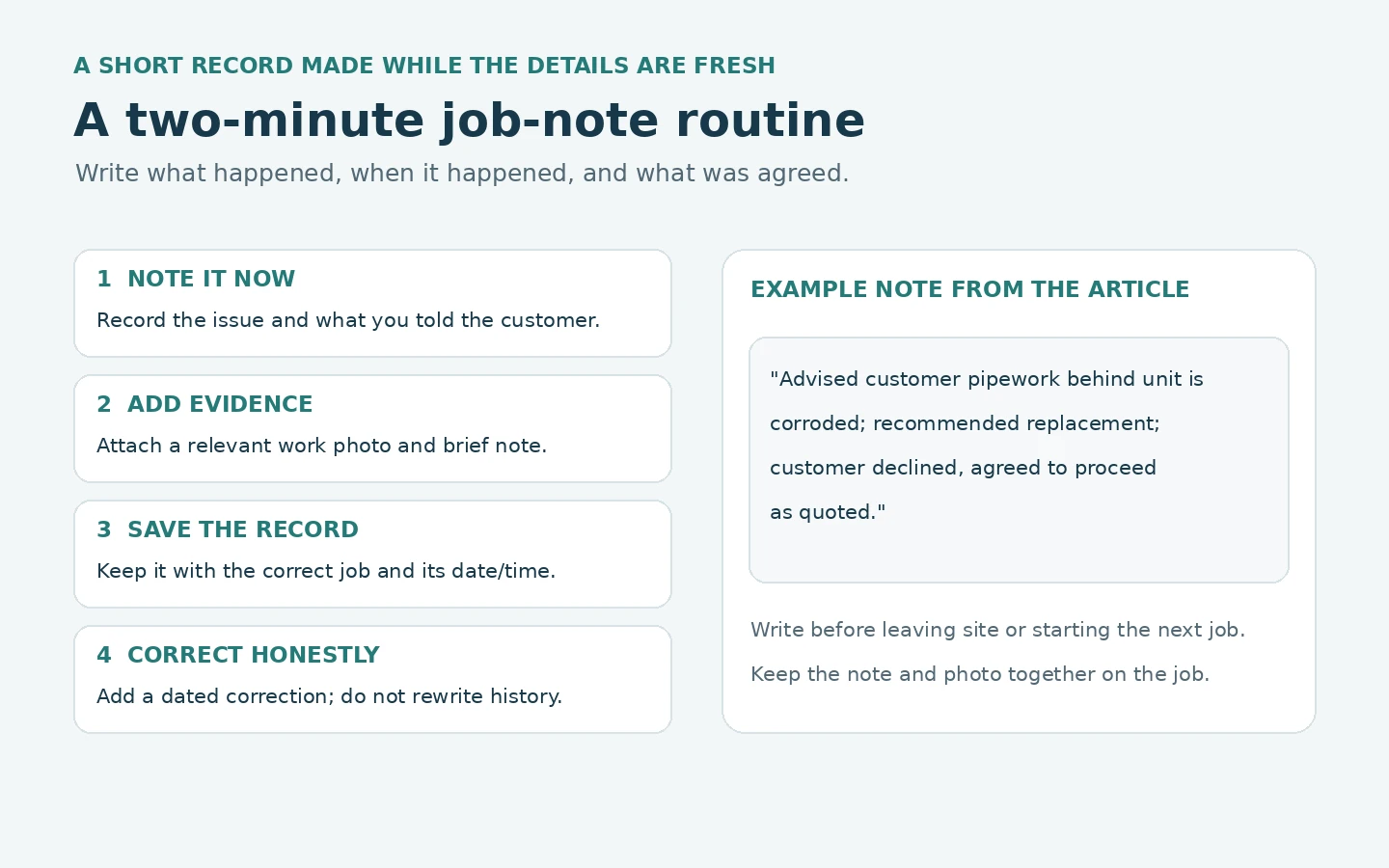
A note written within minutes of the event is worth much more than one written days later. Not only is it more accurate, it's more convincing. If anyone ever asks when you wrote it, "that afternoon" is a far stronger answer than "at the end of the week".
Many software systems record when a note was added. That timestamp adds weight, because it shows the record was made at the time, not rebuilt afterwards.
So build the habit of writing the note before you leave the property. Sit in the van for two minutes. Type or dictate it. Then go.
This also solves a practical problem. By evening, you're tired and you've done six jobs. The details are already blurring. Notes written at that point are vague, and some jobs get no notes at all.
If you can't do it before leaving, do it before starting the next job. The point is to make it a rule: no note, no next job. It sounds strict, but after a week it becomes automatic, like locking the van.
Our guide on stopping admin at night looks at routines that make this painless.
Two-minute notes: how to write them fast on a phone
Speed matters. If notes take ten minutes, they won't get written. Here are ways to keep them under two.
Use voice dictation. Most phones can turn speech into text. Talk through the five questions: "Customer reported no hot water. Found worn thermocouple. Replaced it and relit pilot. Advised the boiler is old. Customer will think about replacement." Check for odd words, then save.
Use a template. Create a standard structure with the five headings, and fill in each line. The structure removes the effort of deciding what to write.
Use short sentences. Don't write paragraphs. A list of fragments is perfectly fine.
Photograph rather than describe. A picture of the corroded pipe is worth many words. Add a short caption.
Save common phrases. If you often write the same thing, such as "Advised customer to keep area clear for 24 hours", save it as a shortcut.
Where you store the notes matters as much as how you write them. Notes in one place, attached to the right job, can be found in seconds. Notes spread across a notebook, text messages and the back of an envelope are as good as lost.
If you use job-management software, check that you can add notes to a job from your phone, and that they are saved with a date and time. Features differ between products and plans, so test it on a real job before relying on it.
The sentences that settle most arguments before they begin
Some phrases are worth writing down in almost every job, because they answer the questions that cause disputes.
"Advised customer that..." Whenever you warn or recommend something, record it. "Advised customer that the old fuse board does not meet current standards and recommended replacement." This shows you flagged the issue.
"Customer declined..." If the customer chose not to follow your advice, say so. "Customer declined replacement at this time." This protects you if the problem later returns.
"Customer agreed to..." Any extra, change or decision. "Customer agreed to additional work at $X."
"Condition on arrival:" A line about the state of things before you began. "Existing tiles cracked around bath." This avoids being blamed for damage that was already there.
"Left site:" How you left it. "Water on, tested, no leaks. Area cleaned."
"Customer present / not present" Who was there, and who you spoke to. This can matter if instructions were passed on second-hand.
These aren't legal magic words. They are simply clear, plain statements that capture the points where misunderstandings usually arise.
Photos and notes work best as a pair
A note says what happened. A photo shows it. Together, they are much stronger than either alone.
Take photos at three points:
- Before you start. The state of the area, any existing damage, the equipment.
- During the job. Anything unexpected you discover.
- After you finish. The completed work and a tidy finish.
Then add a short caption to each. "Corroded pipe behind unit. Shown to customer." The caption connects the picture to the note.
Be careful about privacy. Photograph the work and the area around it, not the customer's private belongings or family. If a photo shows more than it needs to, crop it.
Our guide to before-and-after photos for tradespeople goes into where to take them and how to keep them organised.
Making notes findable: the filing problem nobody mentions
A note you can't find is no use. Many people write notes and then lose them.
The simplest rule is to attach every note to the job it relates to, and name each job in a way you'll remember. A job called "Smith, 14 Oak Road, boiler" is easy to find. A job called "Tuesday job" is not.
Here are some habits that help.
Use a consistent naming pattern. Customer surname, address or street, and the type of work.
Keep one record per job. Resist the temptation to start a second record for a return visit unless it's a genuinely new job.
Back up. If your notes live on a phone, make sure there's a copy elsewhere. A lost or broken phone shouldn't wipe out your records. Our guide to a paper backup plan for when software fails goes through this.
Know how long to keep them. Different countries and trades have different rules on how long records must be kept, particularly for safety-related work. Check the official guidance where you operate, and ask your trade body or accountant if unsure.
Be able to find them quickly. Test yourself. Pick a customer from three months ago and see how long it takes to find the notes. If it takes more than a minute, your system needs work.
When a customer asks to see your notes
Sooner or later, a customer may ask what you wrote about their job. You should be ready.
First, remember that notes may be seen. If you write them calmly and factually, this is rarely a problem.
Second, if the request is part of a dispute, think carefully before you respond. You may want to take advice. Your trade association, insurer or a solicitor may be able to help. Sharing records can be a good way to resolve a disagreement, but how and when is worth considering.
Third, if the request is simply curiosity, a summary is often enough. "We replaced the thermocouple and relit the pilot. We also advised that the boiler is getting old."
Data protection rules in many countries also give people rights over personal information held about them. These rules vary, so check the official guidance where you work, and ask an adviser if you're unsure.
The best outcome is that you never need to show anyone. But having notes you'd be comfortable sharing makes it easier to write them well in the first place.
Notes that help you win work as well as protect it
So far, we've talked about defence. But notes have an offensive use too.
Repeat jobs. When a customer calls again, you can say, "I see we replaced the thermocouple in March. How's the boiler been since?" That impresses them. It shows you remember.
Quotes. Notes from previous jobs help you quote similar ones faster and more accurately.
Upselling, gently. A note like "Customer interested in replacing old taps in future" gives you something to follow up on, honestly and without pressure.
Training. If you take on a helper, your notes show how you work, which helps them learn. See our guide on training a new helper on your job app.
Reviewing your business. Looking back at a month of notes shows patterns. Maybe a certain type of problem keeps recurring, or a certain product keeps failing. That's useful information for pricing and purchasing.
Notes, in other words, are not just insurance. They're a quiet memory for your business, one that gets more valuable over time.
Five note-keeping mistakes and how to fix them
Before you start, here are five common slips.
Writing too much. Long notes don't get written or read. Stick to the five questions.
Writing too little. "Done" isn't a note. Include what you found and what you advised.
Writing opinions. Stick to facts. Opinions look bad if the note is read in a dispute.
Writing late. Notes written days after the event are weaker and often incomplete.
Writing in different places. Pick one home for notes and use it every time.
If you recognise yourself in any of these, don't worry. Pick one fix and try it for a week. Small changes are easier to keep.
A good note and a bad note, side by side
Rules are easier to remember with examples. Here are three pairs, each describing the same hypothetical visit.
The bad note: "Fixed boiler. Customer happy."
The good note: "Customer reported no hot water since Tuesday. Pilot light out, thermocouple worn. Replaced thermocouple, relit pilot, ran for ten minutes with no faults. Advised that the boiler is about fifteen years old and may need replacing in future. Customer said they would think about it."
Both took the same visit. Only one of them helps you six months later.
The second pair is about an extra.
The bad note: "Did the tap too."
The good note: "Customer asked for second tap to be replaced while on site. Quoted $X, customer agreed. Done, tested, no leaks."
The third pair is about a refusal.
The bad note: "Told them about the pipe."
The good note: "Pointed out corroded pipe behind unit and showed photo. Recommended replacement. Customer declined for now and asked us to proceed as quoted."
Look at what the good notes share. They use plain verbs: reported, found, replaced, advised, agreed, declined. They include the numbers that matter and the decisions the customer made. They do not contain opinions.
They are also not much longer. The good note in the first pair is about forty words. It takes under a minute to dictate. That is the whole investment, and it is the difference between a record that protects you and a scribble that does not.
Common worries about writing job notes
Do I need to keep notes for small jobs?
A single line is often enough: "Replaced washer, tested, no leaks." The habit matters more than the length.
Can notes be used as evidence?
Records made at the time can support your account, but how they are treated depends on the situation and the country. If you face a formal dispute, take advice.
Should the customer sign my notes?
For major work, a signature on key points can help. For routine jobs, it's usually unnecessary.
What if I make a mistake in a note?
Don't delete it. Add a correction with the date. "Correction: pipe was copper, not plastic." This keeps the record honest.
How long should I keep job notes?
It depends on your trade, your country and the type of work. Check the official guidance and ask an adviser if you're unsure.
Two minutes before you drive away
Good job notes are short, factual and written at the time. They answer five questions: what was asked, what you found, what you did, what you told the customer and what was agreed.
Take photos alongside them. Store everything against the right job. Write before you leave the site, or before you start the next job.
On your next job, try this: before you drive away, spend two minutes writing the five lines. Do it for a week. If a customer ever calls months later with a question, you'll be glad you did, and you'll be calm because the answer is already written down.