
Electrical software
Best Software for Electricians: Match the Tool to the Job Type
Match Jobber, Housecall Pro, Tradify, ServiceTitan and FieldEdge to service calls, quoted projects and multi-stage work.
 12 min read

An electrician can quote three very different jobs before lunch: a failed socket that needs a quick visit, a panel upgrade that needs a persuasive estimate, and a commercial fit-out that will be billed across several stages. All three appear on the same calendar, but they do not place the same demands on software.
The practical answer is to shortlist by job type. For a service-call business, speed from enquiry to payment usually matters most. For quoted residential work, scope, options and variation records carry more weight. For longer projects, progress billing and cost visibility become harder to compromise.
This page is the shortlist by job type. If you already have candidates and need a disciplined way to trial them, use our separate guide to choosing job-management software for a small electrical business. That guide focuses on handoffs, mobile use, migration and implementation rather than naming a winner for each work pattern.
The quick shortlist
| Dominant work pattern | Start with | Why it reaches the shortlist | What to prove in a trial |
|---|---|---|---|
| Short service calls and reactive work | Jobber or Housecall Pro | Both centre everyday home-service workflows such as scheduling, estimates, invoices, customer communication and payments. | How many taps it takes to accept, dispatch, document and invoice a small job from a phone. |
| Quoted residential and small commercial projects | Tradify | Its official plan information includes quoting, timesheets, bills and job costs, accounting sync and progress invoicing. | Whether estimated labour and materials remain understandable after changes and partial invoices. |
| Multi-team service operations | ServiceTitan or FieldEdge | Both are positioned for more structured dispatch, pricebook, reporting and multi-technician service operations. | Implementation effort, licence structure, data migration, reporting and the total quoted cost. |
These are starting points, not universal rankings. A five-person company doing commercial refurbishments may need stronger project controls than a twenty-person service company. Work shape matters more than headcount alone.
Three electrical jobs expose different software needs
Before comparing feature lists, divide a recent month of work into three buckets: short service calls, quoted small projects and multi-stage jobs. Count jobs, but also note which group creates the most chasing, invoice delay and uncertainty. The largest bucket is not always the most expensive one to manage badly.

Short service calls: remove steps, not evidence
A reactive call may begin with a short phone description and end on the same day. The software has to capture the customer, address and fault without turning a twenty-minute repair into a long administrative task. The field record still needs enough detail for the office and customer to understand what happened.
Jobber is a sensible starting point when the desired flow is request, schedule, visit, invoice and payment. Its official material describes scheduling, quoting, invoicing, payments, job forms, client communication and job costing across its plans. Housecall Pro targets a similar home-service workflow, with scheduling and dispatch, estimates, invoices, payments, customer communication and online booking among the capabilities described on its official pages.
Do not decide from the calendar view. Time one complete service call on the technician's real phone. Include a photo, materials, a customer approval, an invoice and a payment-status check. If the team still needs a message thread to explain the job, the workflow is not fast enough.
Quoted upgrades: preserve the commercial story
A consumer-unit or panel upgrade, rewiring package or small fit-out starts with a quote and often changes after work begins. Here the important record is not simply “job complete.” It is the chain from original scope to approval, labour, materials, variation and final amount.
Tradify deserves attention for this pattern. Its official pricing and feature pages describe quotes, invoices, timesheets, bills, job-cost tracking, QuickBooks Online and Xero sync, and progress invoicing. That combination is relevant when the estimate must remain connected to what was bought, worked and billed.
The trial should include an awkward change. Add an item that was not in the accepted estimate, record who approved it, add labour and materials, and ask a second person to prepare the invoice. They should understand the difference without calling the person who attended the site.
Multi-stage work: each claim needs a defensible milestone
Longer residential work and commercial projects can create a cash-flow problem even when the final margin looks healthy. Labour and materials leave the business before the customer pays the final invoice. Progress invoicing helps only when the milestone, evidence, variation and amount claimed remain aligned.
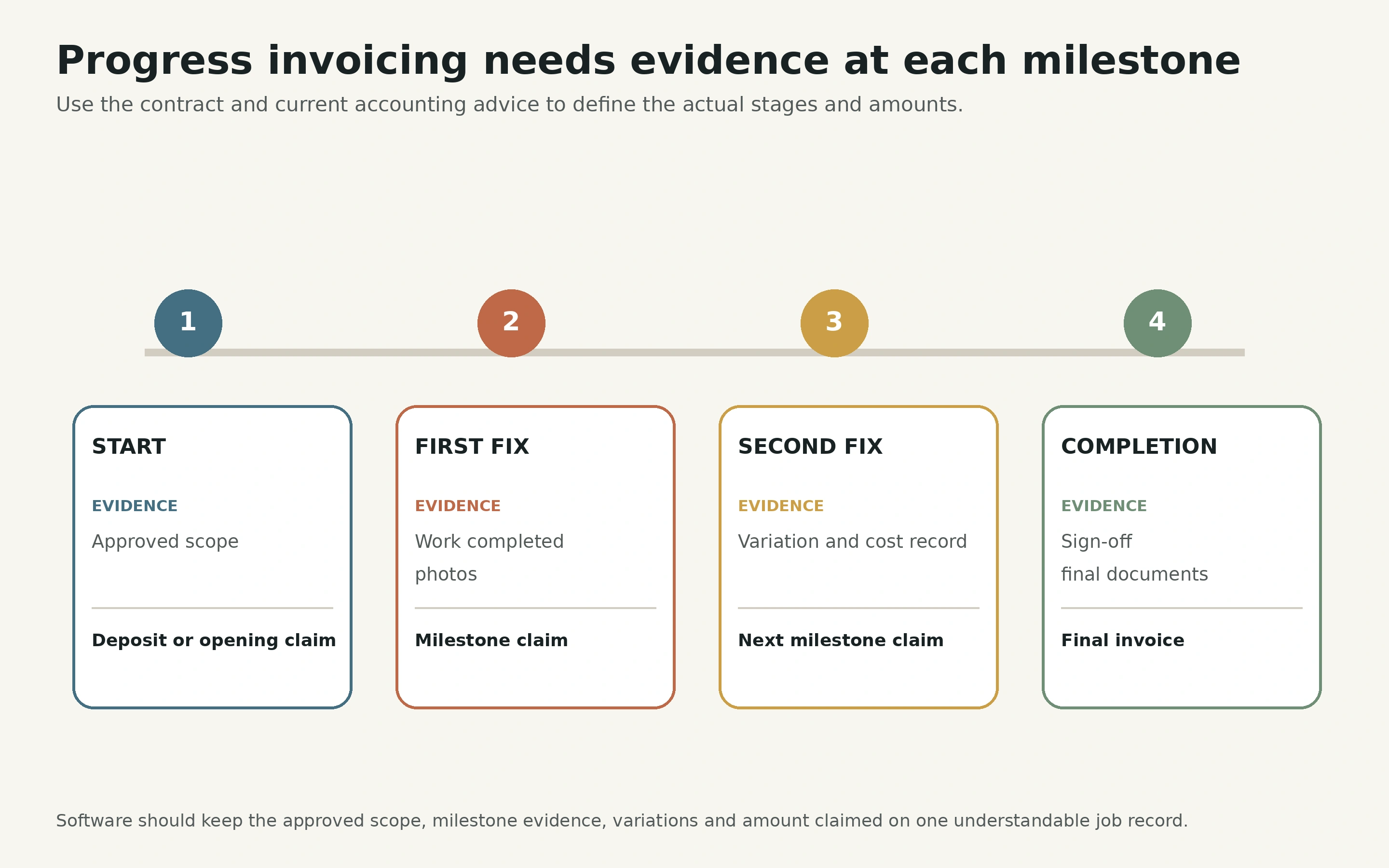
Tradify publicly describes deposits, progress payments and retentions. For larger service organisations, ServiceTitan and FieldEdge also belong in the conversation because their official product material emphasises structured dispatch, pricebooks, reporting, customer records and field-to-office workflows. Neither should be treated as an automatic upgrade. Both require a sales conversation for the actual commercial fit, and implementation burden can outweigh the benefit for a small team.
Use the payment stages in your contract, not a generic percentage copied from another contractor. At each stage, define what work is complete, what evidence is required, how approved changes are handled and what accounting record is created. Legal, tax and payment rules vary by location, so have the process checked where necessary.
Product fit by operating model
Jobber: straightforward service administration
Jobber is the most natural first trial when an electrical business wants one broad home-service system and most jobs move quickly from request to visit and invoice. Its attraction is the connected path rather than a uniquely electrical function.
Check the exact plan for job costing, automations, advanced reporting, forms and any accounting or payment feature you consider essential. A capability shown on the product site may sit above the entry plan or require an add-on.
Housecall Pro: service workflow with customer-facing tools
Housecall Pro is another credible service-led option, particularly when online booking, dispatch, customer communication, estimates and payments need to sit in one operational flow. Its official pricing page publishes plan bands, but the right comparison is the plan that includes your required users and features, not the lowest advertised figure.
Test what happens when a “quick” call becomes a return visit or quoted repair. The system should preserve the original diagnosis and move the work forward without creating duplicate customer or job records.
Tradify: quoted work and job-cost visibility
Tradify is a stronger initial match when quotes, labour, bills and material costs need to stay visible across a project. Progress invoicing and accounting sync are especially relevant to businesses that regularly take deposits or bill at milestones.
Verify regional availability, tax setup, accounting behaviour and plan entitlements in your own market. “Syncs with accounting” is not enough. Test which customer, invoice, payment, tax and cost fields move, in which direction, and what happens after an edit.
ServiceTitan and FieldEdge: structured operations at a higher level of complexity
ServiceTitan and FieldEdge are better treated as operational platforms to evaluate than as default recommendations for every electrician. Their official material is strongest around dispatch, field operations, pricebooks, reporting and larger-team control. FieldEdge also publishes electrician-specific material and QuickBooks-oriented workflows.
Ask for the total first-year proposal, including licences, implementation, onboarding, migration, add-ons, payment costs and any required contract term. Then run the same representative job used with the smaller platforms. More configuration is worthwhile only when it removes a real coordination problem.
Accounting should receive a clean result
QuickBooks, Xero and Sage are accounting systems, not substitutes for field workflow. The job platform should send a clean customer, invoice, tax and payment record without forcing someone to reconstruct the site work in the ledger.
Choose one source of truth for customer details, invoice status and job costs. Test a new customer, a deposit, a variation, a partial payment, a credit and a corrected invoice. Check for duplicate contacts and confirm which system controls each field after the sync.
If the accounting connection cannot handle your real workflow, budget the manual step honestly. A dependable weekly export may be safer than a nominal integration that creates duplicate or incomplete records.
Electrical records still need their own route
None of these broad field-service systems should be assumed to satisfy the certification, inspection, test-result or retention duties that apply to your work and jurisdiction. The useful question is where the authoritative document is created and how it returns to the correct customer and job.
During a trial, attach a non-sensitive sample document, find it from the office account, export the job record and check access permissions. If a specialist compliance tool remains separate, define the handoff rather than pretending one system replaces it.
Run the same six-step test in every finalist
Use one real, anonymised job that includes a quote, a change and a field-to-office handoff. Keep the test identical across every product.
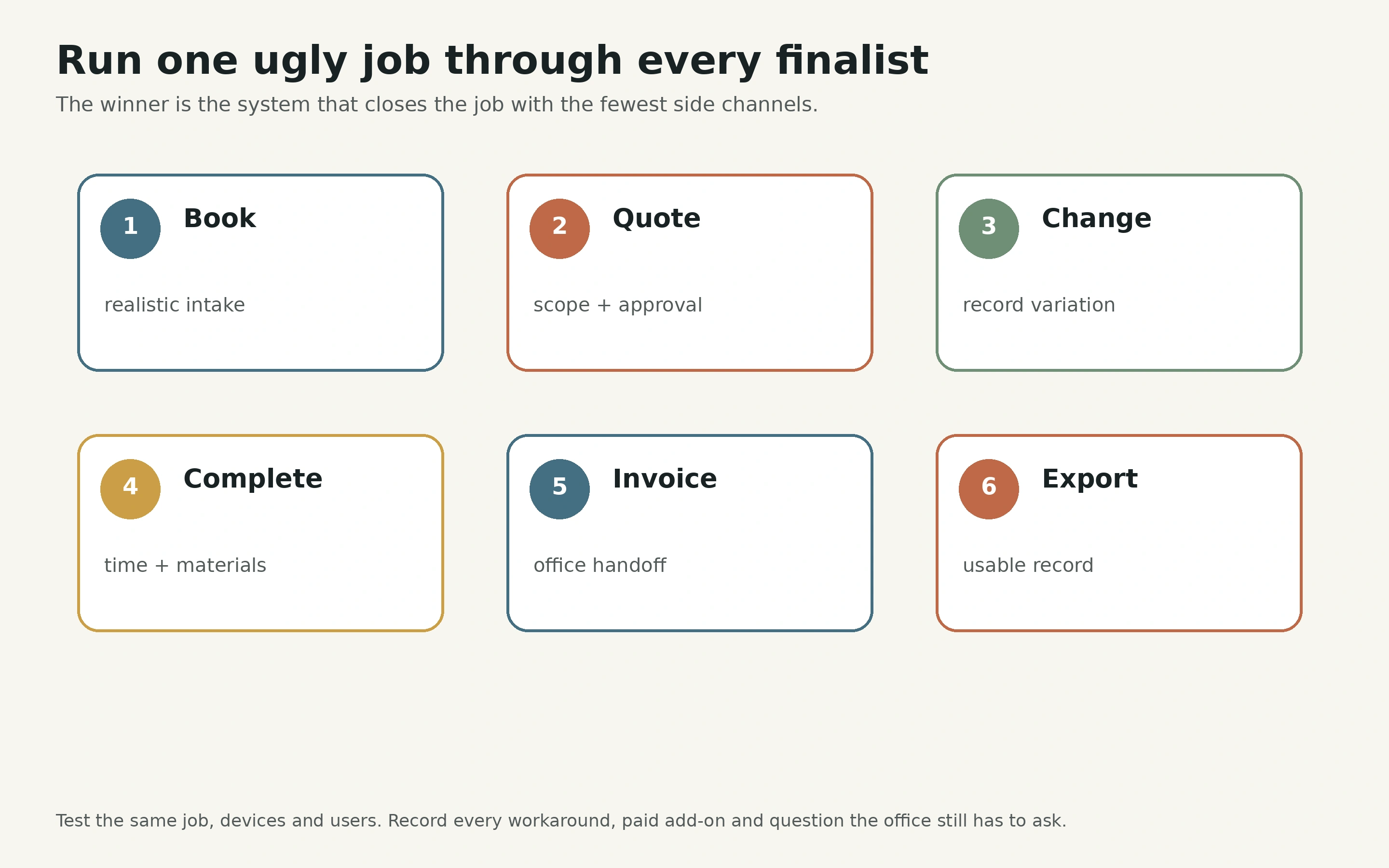
- Book: create a realistic customer enquiry with incomplete information.
- Quote: build a scope with labour, materials and one optional item.
- Change: add a variation and preserve the approval trail.
- Complete: record time, materials, photos, documents and the next action on a field device.
- Invoice: let a different person prepare the invoice without verbal help.
- Export: produce a usable customer and job record you could retain if you left the platform.
Record every workaround, paid add-on and side channel. Use the same job, phones and users in each product. That turns a software demonstration into comparable evidence.
The choice in one sentence
Start with Jobber or Housecall Pro for short service calls, Tradify for quoted and progress-billed projects, and ServiceTitan or FieldEdge only when larger-team operational control justifies the implementation and quoted cost. Then prove the choice with one difficult job before moving live data.