
Costs & Pricing
How to Take a Deposit on a Trade Job Without Feeling Awkward
A deposit isn't a sign you don't trust the customer. It's what holds a space in your diary. How to take a deposit on a trade job, and what to say.
 12 min read

Asking a customer for money upfront feels awkward, but once you know how to take a deposit on a trade job, it becomes just another step in booking.
There is a particular silence that follows the words "I'll need a deposit." It lasts about two seconds, and in those two seconds you can feel the whole job wobble.
So lots of tradespeople don't ask. They start the work, buy the materials, block out the days, and hope the final payment comes through on time. Most of the time it does. When it doesn't, the cost is bigger than anyone expected.
This guide is about how to take a deposit on a trade job in a way that feels normal for both of you. It covers what a deposit is actually for (which isn't what most people think), how much to ask for, the exact words to use, and what to do when a customer pushes back. There's also a small change in wording that makes customers far more comfortable, and it appears about halfway down.
What a deposit actually buys, and why it isn't about trust
Most people treat a deposit as a test of trust. If I ask for money upfront, it means I don't trust you. If you refuse to pay, it means you don't trust me.
That framing is the reason so many deposits feel awkward. It is also wrong.
A deposit buys two practical things.
It buys your time. When a customer books you for next Tuesday, you turn down other work for that slot. If they cancel on Monday night, the slot is empty and nobody can fill it. A deposit means the booking has a cost on both sides, so it is taken seriously by both sides.
It buys your materials. If a job needs something ordered, such as a boiler part, a special tile or a made-to-measure item, you are spending your own money before you've been paid. A deposit moves that cost to the person who benefits from it.
Notice that neither of those is about trust. They are about who carries a cost that exists because of the customer's decision.
Once you see a deposit that way, the conversation changes. You aren't asking whether they can be relied upon. You're explaining how the booking works.
The sums that tell you how much deposit to ask for
There's no single correct amount. The right deposit depends on what you stand to lose if the job doesn't go ahead.
Work it out with two questions.
Question one: what will I spend before I'm paid?
Add up any materials you must order, any special items, and any costs you can't return. This is your cash exposure.
Question two: what is the slot worth if it goes empty?
If you block out two days and the customer cancels, what could you realistically have earned with that time? You don't need to charge the whole amount, but you should know what it is.
Here's a hypothetical example, with round numbers chosen only to show the arithmetic.
You're booked to fit a new bathroom suite over three days. The customer's chosen items cost you $1,200, ordered specially. The three days are worth about $1,500 in labour.
If the customer cancels after the items arrive, you're holding $1,200 of stock and have lost three days of work.
A deposit that covers the special order, perhaps $1,200, removes the biggest risk. A larger one that also covers a share of the labour reduces the second.
For smaller jobs, it can be simpler. Some businesses ask for a modest percentage of the total, and some ask for the cost of the materials. Choose a rule you can explain in one sentence, and use it consistently.
For very small jobs, a deposit may not be worth the friction. A booking for a thirty-minute repair doesn't need one, though a cancellation policy might. We'll come back to that.
A reframe that makes customers relax: it's a booking, not a payment
Here's the small wording change promised earlier.
Instead of "I need a deposit", say "To book you in, I take a booking payment of X, which comes off the final bill."
The difference is subtle, and it matters. A deposit sounds like a demand. A booking payment sounds like a normal step in reserving a service.
Think of how people book other things. Nobody is surprised to pay something to reserve a table for a big group, or a place on a course, or a hotel room. The payment confirms the slot. It is understood.
The words "comes off the final bill" are just as important. They tell the customer that nothing extra is being added. They are not paying more. They are paying earlier.
Try the full sentence aloud:
"To book you in for Tuesday, I take a booking payment of $X, which comes off your final bill. I'll send the link now, and as soon as it's paid, the dates are yours."
There's nothing to argue with. It states the cost, the benefit and the next step.
When to ask: the moment that makes it easiest
Timing matters more than most people realise.
The easiest moment to ask for a deposit is straight after the customer says yes. They have just decided they want you. They are in a positive frame of mind. They want to know what happens next.
If you wait until later, you give them time to wobble. They might get a second quote. They might talk to a friend. They might feel less sure.
So fold the deposit into the acceptance:
- Send the quote, with the booking payment listed on it.
- When the customer accepts, send a payment link or details immediately.
- Confirm the dates only once the payment has arrived.
That final step is important. Don't confirm the slot before the payment lands. Say, "I'll pencil you in, and as soon as the booking payment comes through, it's locked." This gives the customer a reason to act quickly and keeps you in control of your diary.
If you can put the deposit on the quote itself, even better. Customers who see it in the quote don't feel ambushed afterwards. They accepted the whole package, including the payment.
Our guide to writing quotes that win more trade jobs shows how to make the "yes" step as easy as possible.
Three ways to set up deposits, and which suits which job
Different jobs need different structures. Here are three common ones, with a note about when each fits.
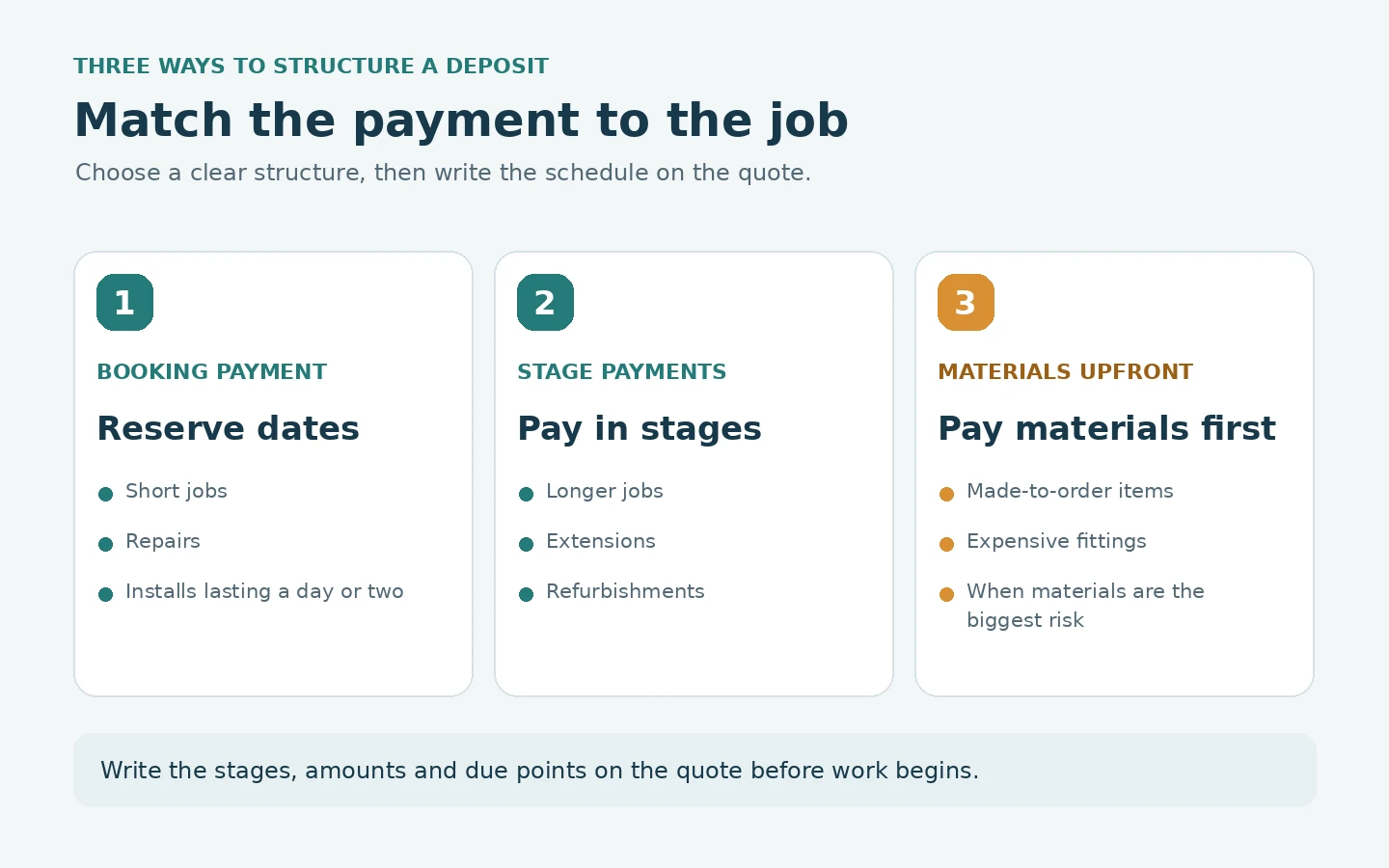
A single booking payment. The customer pays a set amount to reserve the dates. The rest is paid on completion. This suits short jobs, repairs and installs lasting a day or two.
Stage payments. The job is split into stages, and each is paid before or after it is completed. For example: booking payment to start, a second payment when the first fix is done, and a final payment when everything is finished. This suits longer jobs, such as extensions and refurbishments, where waiting until the end would leave you carrying a lot of cost.
Materials upfront. The customer pays the cost of materials before you order them. Labour is paid afterwards. This suits jobs where materials are the biggest risk, such as made-to-order items or expensive fittings.
Whichever you choose, write down the schedule on the quote. List the stages, the amounts and the point at which each is due. A customer who sees the plan at the start is much less likely to be surprised in the middle.
A tip for staged work: link each payment to something the customer can see. "Payment two is due when the pipework is finished and the walls are ready for plastering" is clearer than "after two weeks". It ties money to progress, which feels fair to both sides.
What to do when the customer says "I don't normally pay upfront"
You will hear this sometimes. It isn't an attack. It's a reaction to something unfamiliar.
The first rule is not to defend yourself. Respond with warmth and a reason.
"That's fair. For bigger jobs, I take a booking payment so I can order materials and keep the dates free. It comes off the final bill, so you're not paying any extra."
If they still hesitate, try offering a choice. This often works because it gives them control:
"I can either take the booking payment now and lock in the dates, or you can pay for the materials when they arrive. Which would you prefer?"
Both options protect you. The customer picks one, and the conversation moves forward.
Some customers will say, "The other quote doesn't ask for one." That might be true. You can acknowledge it without changing your position:
"They might not. I find it keeps both sides committed, and it means I can start on the day we agreed. If you'd rather go with them, I completely understand."
Don't chase. Some customers who push back at this point are the ones who would have caused trouble later. It is better to find out now.
And one more thing. If a customer is genuinely uncomfortable paying a stranger a large sum online, offer to explain what's covered, share a few reviews or put the agreement in writing. Trust grows when you make it easy to check you.
The part about refunds, written in plain English
If you take deposits, you need to decide what happens if the job doesn't go ahead. This is the part that makes tradespeople nervous, but it can be simple.
Write down a short policy that answers three questions:
- What if the customer cancels with plenty of notice? Many businesses refund the booking payment in full, minus any costs already incurred, such as materials ordered.
- What if the customer cancels at the last minute? You may keep some or all of the booking payment to cover the lost slot.
- What if you have to cancel? Refund everything promptly, and say sorry.
Keep the wording friendly and clear. For example:
"If you need to change the dates, just let me know. If you cancel more than a week before the start, I'll refund your booking payment less the cost of any materials I've already ordered. After that, I may keep part of it to cover the time I've held for you."
This isn't legal advice. Consumer rules about deposits and cancellations differ by country and by the type of work, so check the official guidance where you work, and ask your accountant or a trade association if you are unsure. The principle is simple: say what will happen before it matters, in words the customer understands.
How to collect the money without a clunky process
A deposit loses its benefits if it is hard to pay. Make the payment path as short as you can.
Here are the options, from the simplest upward.
- Bank transfer details on the quote or in a message. This works, but it needs the customer to open their banking app and type carefully, so some will delay.
- A payment link that takes the customer to a page to pay by card or bank. This is faster, and you can see when it has been paid.
- A payment taken as part of the quote approval, where the customer accepts the quote and pays in the same flow. This is the smoothest, because the commitment and the money arrive together.
Many job-management tools describe features like these, but what is available differs between products and plans, and charges may apply. Check the details with each provider before you rely on them, and test the customer's side of the process yourself.
Whatever method you use, send a receipt. A simple "Thanks, I've received your booking payment of $X for the work on 12 May" does three things. It confirms the amount, restates the date and reassures the customer that the process is working.
Keep a record of every deposit in one place, even if that's just a spreadsheet. When the final invoice goes out, the deposit needs to appear on it as a credit, otherwise you'll create confusion. Our invoicing guide shows how to get the final step right.
When not to ask for a deposit
A deposit is a tool, not a rule. There are times when it adds friction without adding much protection.
Small, same-day jobs. If you're coming out to fix a tap this afternoon, the booking payment isn't worth the hassle. A minimum charge does the job more naturally. Our guide to the minimum call out charge explains how.
Regular customers with a good track record. If someone has paid you promptly for years, you might waive the deposit. Decide this as a rule rather than a favour.
Emergencies. When a customer has water through the ceiling, you're unlikely to ask for a booking payment before you turn up. Payment on completion is normal here.
When the risk is genuinely low. A job with no special materials, flexible dates and a short duration may not need one.
The point is to match the protection to the risk. If you ask for a deposit every time, it can feel like a ritual. If you ask only when something is at stake, customers understand why.
Getting comfortable with the ask: a few ways to practise
Most of the awkwardness lives in your head, and it fades with repetition. Here are some ways to build the habit.
Write your sentence down. Choose the wording that sounds like you, and put it on a card by the phone. When the moment arrives, you won't need to improvise.
Say it aloud once or twice. It sounds silly, but a sentence that has been spoken before comes out easier the first time you say it to a customer.
Start with one job. Pick the next job that clearly justifies a booking payment, and try the new approach there. Notice how the customer reacts. Most of the time, they just say "OK, send me the link."
Keep a tally. After a month, count how many customers agreed without fuss. This will probably be most of them, and the number will make the next conversation easier.
Notice what changes. When you take a booking payment, do you feel less anxious about next Tuesday? Do cancellations become rarer? Our guide on reducing no-shows and last-minute cancellations goes deeper into this.
The deposit questions customers and tradespeople both ask
Do I have to ask for a deposit?
No. It's a business decision. But if you regularly order materials or block out multiple days, a deposit protects you from carrying costs that belong to the customer's decision.
How much deposit should I take on a big job?
A common approach is to cover the materials you must buy before you are paid, plus something towards the time you've reserved. Use a rule you can explain in a sentence, and apply it consistently.
Should the deposit be refundable?
That's your call, but write the policy down before the job starts. Many businesses refund in full with plenty of notice and keep some if the customer cancels late.
Can I put the deposit on the invoice?
Yes. List it as a payment received, so that the final invoice shows the balance due. This avoids confusion and makes it clear that nothing extra is being charged.
What if the customer pays late?
Hold the dates until it arrives. Say so politely when you send the link, and remind them if needed. If late payment is a regular problem, our guide on how to chase late payments has a calm step-by-step approach.
Hold the dates, take the payment, and ask once
A deposit isn't a sign of distrust. It's how a booking becomes real for both sides.
Take one when you're spending money or holding time that you can't easily get back. Call it a booking payment, make clear it comes off the final bill, and ask for it straight after the customer says yes. Write down a simple refund policy, and offer a choice when someone hesitates.
Your next step is small. Look at your next three bookings and decide which, if any, justify a deposit. Write the sentence you'll say. Then say it, once, and see what happens.
Most customers say yes. And the ones who say no have just done you a favour by telling you before the work started.