
Costs & Pricing
How to Mark Up Materials on Trade Jobs Fairly (and Explain It Without Awkwardness)
You bought a tap for $60 and charged $60. Where did the trip to the merchant go? How to mark up materials fairly, and say it so customers nod.
 13 min read
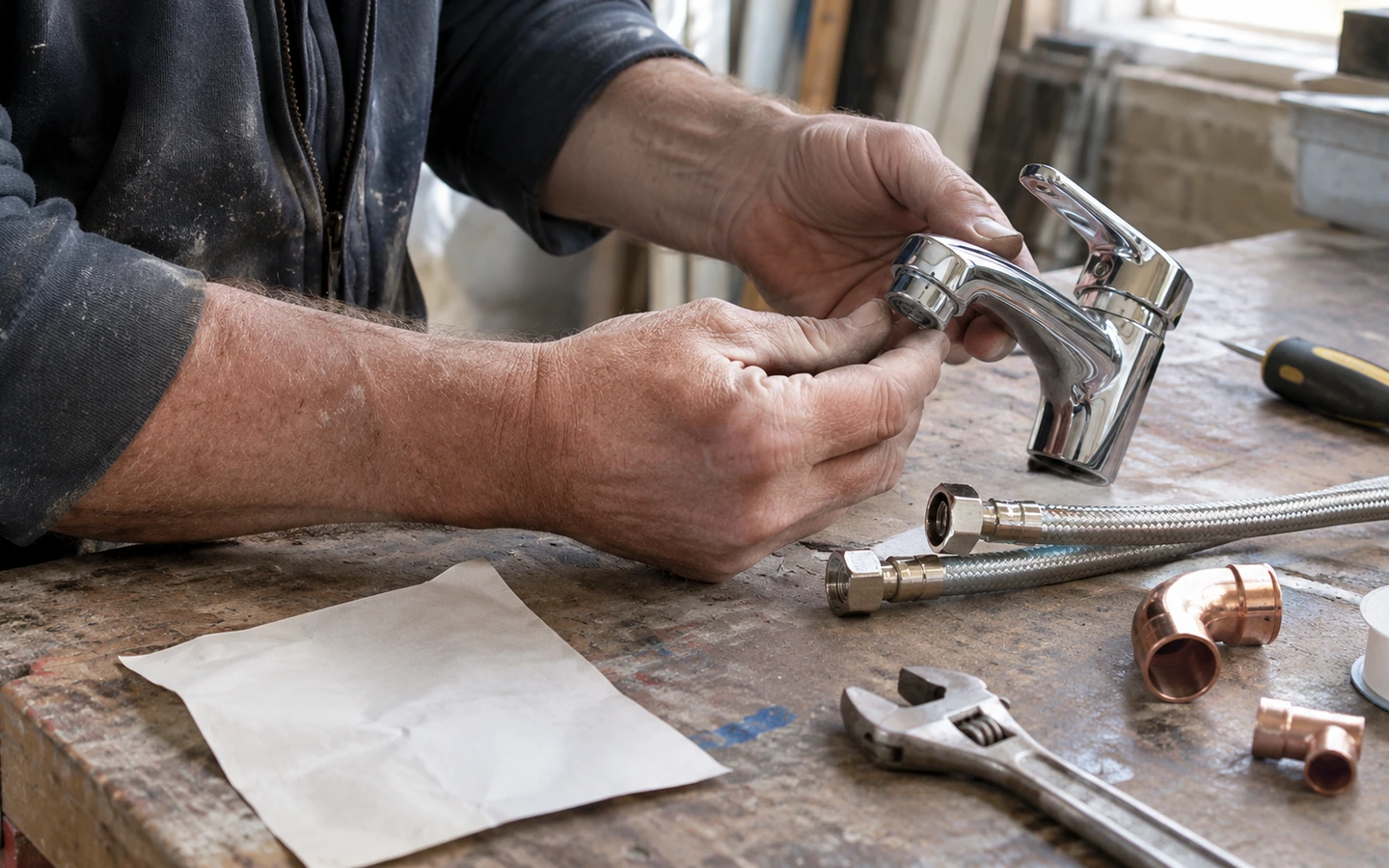
To mark up materials fairly, you first need to see what you are really paying for when you simply buy the part.
You buy a tap for $60. You fit it. On the invoice you write $60.
On paper, it looks honest. You paid $60, the customer pays $60, nobody has been overcharged. Yet somewhere in the day, a trip to the merchant, a wait at the counter, some time finding the right model and a guarantee on the tap if it fails have all disappeared. They've been absorbed by you, for free.
That's the quiet problem with charging materials at cost. It feels fair, but it means every job involving parts includes unpaid work. This guide is about how to mark up materials in a way that's fair to you and clear to your customers. You'll see what a markup is really paying for, how to choose a rule you can explain in one sentence, how to handle the customer who says "I can get it cheaper online", and an unusual way of thinking about markup that makes the whole conversation easier.
What you're really paying for when you "just buy the part"
Most people think of a part as a physical object with a price. For you, it's more than that. Getting it onto the job involves a surprising amount of work and risk.

Finding the right one. Identifying what's needed, checking compatibility, comparing options.
Getting it. Driving to the merchant or arranging delivery. Queuing. Carrying.
Paying for it upfront. You put your cash into the part before the customer pays you. If they pay late, that money is tied up.
Storing it. Items waiting in the van or workshop take space and can get damaged or lost.
Handling returns and mistakes. If the part is wrong or faulty, you deal with it, sometimes at your own cost.
Standing behind it. If the part fails after you fit it, the customer comes to you, not to the merchant.
Admin. Recording, invoicing, accounting for the purchase.
None of these appears on the receipt. All of them are real.
A markup is the way you get paid for this work and risk. It's not a profit on top of a fair price. It's the price of a service the customer would otherwise have to do themselves: sourcing the right part, delivering it, fitting it and guaranteeing it.
When you see it that way, the idea of charging "just the cost" looks strange. You wouldn't offer your labour at cost. Why offer the labour of buying and standing behind a part at cost?
The hidden cost of "at cost"
Let's put some numbers on this, using hypothetical round figures chosen only to show the arithmetic.
Suppose you fit a tap, and you spend half an hour in total on finding it, buying it and handling it. At $40 an hour, that's $20 of your time. Add $8 for the fuel and wear of the trip. Add a small allowance for the risk that some parts go wrong, say $5.
That's $33 of cost that doesn't appear in the receipt. If you charge $60 for a $60 tap, you've paid $33 for the privilege of supplying it.
Do this on a few jobs a week, and it adds up quickly.
Now think about margins. If your total margin on a job is $150 but you've given away $33 on materials, you've lost a fifth of your profit without noticing.
This is also why jobs involving lots of materials can be traps. The more parts you handle at cost, the more unpaid work you do. A job with a low labour element but many components can be much less profitable than it appears.
Our job costing guide shows how to check which jobs make money. Materials handling is often one of the leaks.
The fix isn't to overcharge. It's to charge for the work you actually do.
Pick a rule you can say in one sentence
There's no single correct markup. It depends on your trade, your costs and your market. But you do need a rule.
Here are the common approaches.
A flat percentage. Add a set percentage to the cost of all materials. Simple and consistent. Example: "We charge the cost of materials plus a handling charge of X percent."
A sliding scale. A higher percentage on small, cheap items, and a lower one on large, expensive items. This reflects the fact that handling a $2 washer costs about as much time as handling a $200 boiler part. A flat percentage on the washer produces pennies; a flat percentage on the boiler part produces a large sum that may feel unfair.
A fixed handling fee per job. A set amount to cover sourcing and handling, regardless of what the parts cost. Easy to explain and works well for jobs with many small items.
A price-book price. You set a standard selling price for common parts, based on what they cost you plus your allowance. The customer sees one price per item. Our guide to building a price book shows how.
A mix. Standard prices for common items, and cost plus a markup for special orders.
Which to choose? Look at your own work.
If you fit lots of small parts, a sliding scale or handling fee may suit best. If you buy a few large items, a percentage may work. If you do repeated tasks, a price book is efficient.
Whatever you choose, make sure you can say it in one sentence. "We add 20 percent to cover sourcing, delivery and guarantee." If you can't explain it simply, customers won't understand it.
Test the figure against your costs. Does it cover the time, travel, risk and cash tied up? Does it leave a fair return?
Then check it against the market. Look at what other businesses do, though you needn't copy them. And write it down, so you apply it consistently.
How much is fair? A sense-check rather than a number
People often ask for the "right" markup. It would be misleading to give a figure, because it varies so much. Instead, here are ways to judge whether yours is fair.
Does it cover the real cost of handling? Use the calculation above to find your minimum.
Does it feel defensible to a reasonable customer? Imagine explaining it to a friend. Would they think it sensible?
Is it consistent? Treating customers differently without a good reason can cause resentment.
Is it in line with your trade? Different trades have different norms. Ask colleagues or check trade body guidance.
Does it work for expensive items? A high percentage on a costly part can make the price look inflated. Consider capping or tiering.
Does it work for cheap items? If the markup produces pennies, you may need a minimum handling fee.
Would you be comfortable if the customer saw the receipt? Some tradespeople are happy to show it. Others prefer not to. Either is acceptable, but if you'd be embarrassed, ask why.
Also be aware of rules where you work. In some places, certain types of work have rules about how materials can be charged, particularly for consumers or for public contracts. Check the official guidance, and ask your trade body or adviser if unsure.
Fairness is not about the lowest possible price. It's about a price that reflects real value and is applied honestly.
The reframe: you're selling a fitted part, not a part
Here's the idea that makes this conversation much easier.
Customers don't buy a tap. They buy a working tap, correctly chosen, delivered, fitted, tested and guaranteed.
If you think of what you're selling as "a fitted tap", the question changes. It isn't "why are you charging more than the shop?" It's "what does it cost to get a working tap into my kitchen?"
A shop sells the object. You sell the result. The result includes the knowledge to choose the right model, the effort to obtain it, the skill to fit it and the responsibility if it fails.
This framing helps in two ways.
It helps you feel comfortable. You're not marking up an object. You're pricing a service.
It helps customers understand. Many will immediately see the point. "Oh, it includes getting it and fitting it. Of course."
You can use it in your language. "The price includes the tap, sourcing and delivering it, fitting it and testing it, and our guarantee on the work." Or simpler: "That's the price for the tap supplied and fitted."
Some businesses show a single line, "Supply and fit mixer tap: $X", rather than breaking out the cost of the part and the labour. That avoids the question of markup altogether, and it's a common approach in price books. Others itemise. Both are acceptable. Choose what suits your customers and your trade, and be consistent.
If a customer asks for a breakdown, be willing to give one at a level that makes sense. "Materials $X, labour $Y."
"I can get it cheaper online": a calm reply
This is the objection tradespeople dread.
The customer sees the part online for less and says, "Why are you charging more? I'll buy it myself."
First, don't take it personally. They're comparing the object's price, not the service.
Second, respond calmly. Here are some options.
Explain the difference. "The online price is for the part alone. Mine includes choosing the right one, sourcing it, fitting it and guaranteeing it. If it's wrong or fails, I put it right."
Offer a choice. "If you prefer to supply the part, I'm happy to fit it. I'd need to charge the same labour, and I can't guarantee the part itself. If it's faulty or the wrong size, it'd be your responsibility."
Be clear about terms. Some tradespeople decline to fit customer-supplied parts, because of liability and risk. Others do it with conditions. Decide your policy, and state it up front. Our guide to plain-English terms for small trade jobs shows where to put it.
Check the part. If they supply it, check it's suitable before you start. Note any concerns in writing.
Don't get drawn into a price war. You're not competing with an online shop. You're offering a different thing.
Occasionally, the customer is right that your markup is too high on a specific item. If so, be honest. Consider adjusting, particularly for large items where the percentage becomes large.
Most customers, once they understand the difference, accept the position. And those who truly prefer to buy their own are free to do so, on the terms you've set.
Show the markup in the quote, so the invoice holds no surprises
Transparency early prevents arguments later.
A good quote makes clear what's included, and doesn't hide materials in a vague total.
Options include:
A single supply-and-fit price. "Supply and fit mixer tap: $X." Clean and simple.
Labour and materials separately. "Labour $X, materials $Y." Useful if the customer likes detail.
A materials allowance. For jobs where materials aren't fully known, an estimate with a note: "Materials allowance $X, subject to final choice."
A note on how materials are charged. "Materials are charged at cost plus a handling charge." For larger jobs, especially.
Whichever, be consistent between quote and invoice. If the quote said "supply and fit $X", the invoice should too, unless something changed and you've agreed it.
If materials costs may change before you buy, say so. "Prices of materials can change. We'll tell you if costs rise significantly before ordering." That prevents an unwelcome surprise.
Special orders deserve extra care. If you order something specifically for a customer, a deposit helps. Our guide to taking a deposit on a trade job explains why.
Our guide to writing quotes that win more trade jobs shows how to present prices clearly so customers feel confident.
Keeping your costs and your markup up to date
Materials prices move. If your markup is based on last year's costs, it may no longer be right.
Keep receipts. Attach them to jobs so you know the real cost. This also helps with accounting and job costing.
Update your price book. Check the prices of your most common parts regularly. Our guide on van stock management suggests tracking what you use.
Watch supplier changes. If a merchant changes prices or terms, adjust.
Check trade discounts. If you receive discounts from suppliers, they form part of your margin. Decide how to treat them consistently.
Review your handling costs. If your travel or time costs change, your minimum markup changes too.
Review once or twice a year. A scheduled check keeps things honest. It fits neatly with your price review. Our guide to raising your prices suggests a yearly habit.
Compare quoted and actual. After jobs, check whether the materials you quoted matched what you used. If you often underestimate, adjust your allowances.
If you use job-management or accounting software, check whether it lets you save materials with cost and selling prices, and attach purchase receipts to a job. Features differ by product and plan, so ask each provider and test with a real job. A spreadsheet can do the same.
Mistakes to avoid when marking up materials
A few traps are worth naming.
Charging cost and hoping labour covers it. It often doesn't.
Using a different markup for every customer. It looks arbitrary, and makes it hard to defend.
Hiding charges. Surprises damage trust. Be clear.
Applying a huge percentage to a large item. It can look excessive. Consider capping.
Ignoring small items. Washers, fixings and consumables add up. Use a handling fee, or a "sundries" line.
Forgetting VAT or sales tax. Check how it applies to your quote. Rules differ, so check the official guidance or ask your accountant.
Not checking the rules. Some contracts and sectors limit what you can charge for materials. Read the terms.
Being defensive. If a customer asks, answer calmly.
Never reviewing. Costs change. So should your numbers.
Each is easy to avoid with a little attention.
Markup questions that tend to follow the first conversation
Is it dishonest to mark up materials?
Not if it's reasonable, consistent and reflects real work and risk. Be open about how you charge.
Should I show customers the receipts?
You can, if you wish, but you don't have to. If the quote clearly sets out what's included, receipts are usually unnecessary.
What if the customer supplies their own materials?
Decide your policy. Many tradespeople charge the same labour, and decline to guarantee the materials. Put it in writing.
Do I mark up consumables like tape and fixings?
Many businesses do, through a sundries line or a handling fee. Choose a consistent approach.
How does this fit with a price book?
Very well. A price book lets you set the final price once, including your markup, so quoting is fast and consistent.
Check your last five jobs with materials
Marking up materials isn't about squeezing customers. It's about being paid for the work and risk of sourcing, supplying and standing behind the parts you fit.
Work out what handling really costs you. Choose a rule you can say in one sentence. Sense-check it for fairness. Think of yourself as selling a fitted part, not a part. Answer "I can get it cheaper online" calmly. Be clear in quotes and review your numbers regularly.
Your first step is a small one. Take your last five jobs with materials. For each, note the cost of the parts, the time you spent getting them and what you charged. If you charged cost, add up the unpaid time.
The result may be the nudge you need to put a sensible rule in place.