
Software comparison
ServiceM8 vs Tradify for Solo Operators and Small Teams
On paper they look like twins. The real difference is how each one charges, and that can change the right answer as your team grows.
 10 min read

At first glance, ServiceM8 and Tradify look like near twins. Both target trade and field-service businesses that want to manage work from enquiry through quoting, scheduling, job completion and invoicing. Compare their feature descriptions and you'll struggle to find a winner, because the public descriptions overlap substantially.
The clearest difference is quieter, and it's about money: what each one counts when it works out your bill. Get that right and the choice is often easier than you'd think. This guide starts there, looks at what the two do day to day, and shows what each costs at one, three and five people using the UK prices we checked. Then it gives you a trial script so your own jobs make the final call.
Currency note. Converted prices are approximate USD estimates based on the European Central Bank reference rates for 25 September 2026, when 1 GBP ≈ $1.33. Original GBP prices are shown in brackets. Exchange rates and card-provider rates change, so check the vendor's current billing currency, tax or VAT treatment and checkout total before buying.
The first difference: what you're paying for
ServiceM8 publishes account-level plans with unlimited users. On the UK page we checked, paid plans run from about $33 (£25) to about $356 (£269) a month, and every paid plan includes unlimited users. There's also a Free plan at $0 (£0) for one user, capped at 30 new jobs a month. What limits you isn't headcount, it's how many jobs you run.
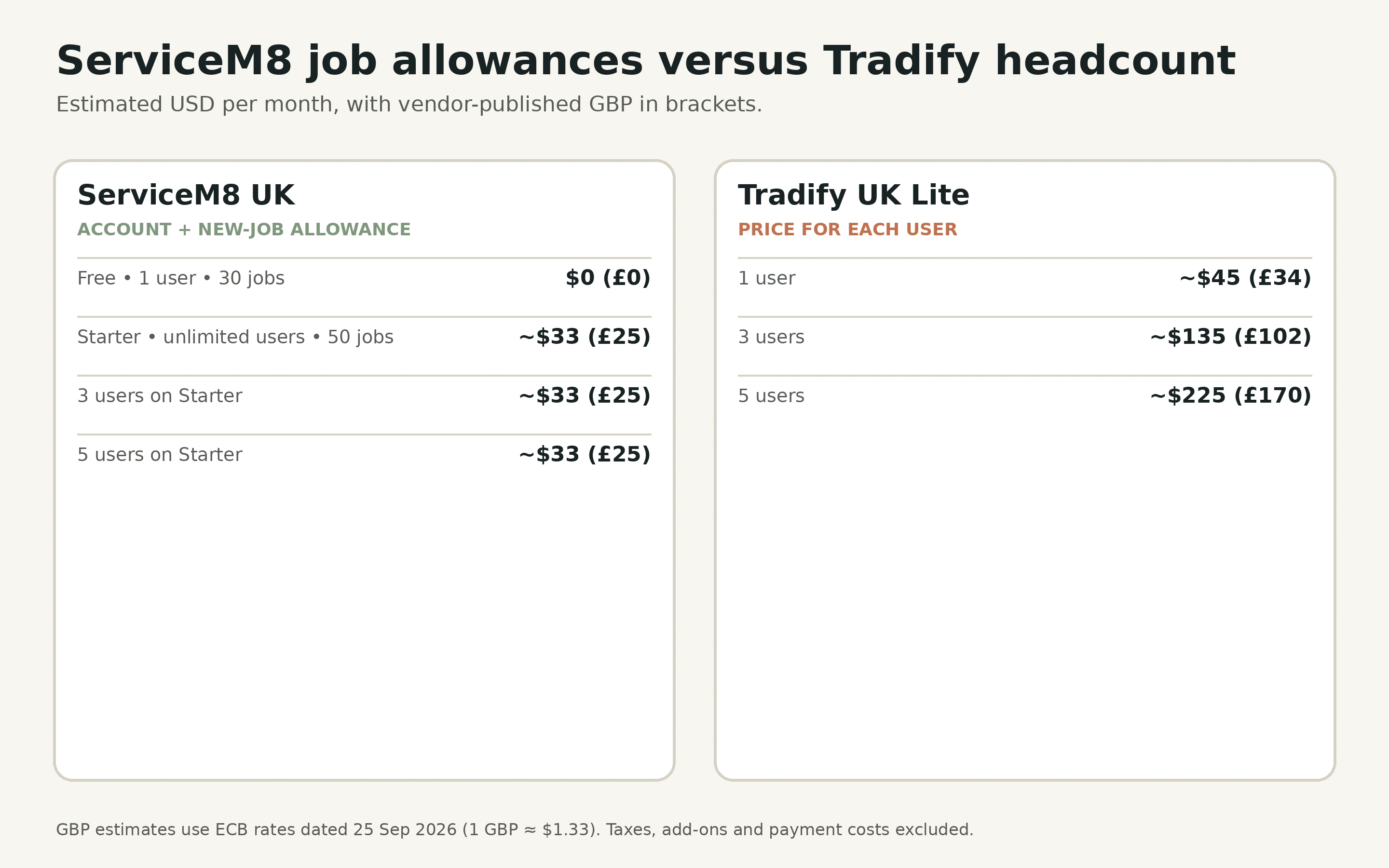
Tradify prices by person. Its UK plans are Lite at about $45 (£34), Pro at about $49 (£37) and Plus at about $58 (£44) per user per month.
Per-user pricing can be competitive for one or two people, but it rises with each person you add. Unlimited-user pricing can make growth easier to model, but the features you need may sit on a higher plan. So compare the exact plan you'd need, not the entry price.
What that looks like at one, three and five people
| Business size | ServiceM8 UK | Tradify UK Lite |
|---|---|---|
| 1 user | $0 (£0)/month Free, limited to 30 jobs; or about $33 (£25)/month Starter | About $45 (£34)/month |
| 3 users | About $33 (£25)/month Starter, unlimited users and 50 jobs | About $135 (£102)/month |
| 5 users | About $33 (£25)/month Starter, unlimited users and 50 jobs | About $225 (£170)/month |
These are estimated USD equivalents of monthly GBP prices rechecked on the live UK pricing pages on 27 September 2026. ServiceM8 charges by account and monthly job allowance on paid plans, and Tradify Lite charges per user. Taxes, add-ons, payment costs and higher plans are not included in these totals.
Here's how that plays out by situation:
- A solo owner with no more than 30 new jobs a month: ServiceM8 Free is the lowest published entry point, subject to its limits and to how well it works on your devices.
- A three- or five-person team with no more than 50 new jobs a month: ServiceM8 Starter has the lower published subscription total.
- A small team that needs Tradify's trade-focused workflow: assess Lite at the full seat count, and move to Pro or Plus only when a feature you need justifies it.
Two cautions. ServiceM8's 50-job allowance can become the limit for a busy team, and the required features may call for a higher plan than Starter. And Tradify's Lite plan may not contain everything you need, so a missing feature can change the comparison.
The second difference: what each one promotes
| Decision factor | ServiceM8 | Tradify |
|---|---|---|
| Core audience | Trade contractors and home-service businesses | Tradespeople and trade businesses |
| UK pricing model | Account-level plans with unlimited users | Plans priced per user |
| Published UK monthly range | $0 (£0) Free, then about $33 (£25) to about $356 (£269) by plan | About $45 (£34) to about $58 (£44) per user by plan |
| Promoted workflow areas | Scheduling, job cards, time, CRM, job history, invoicing and payments | Enquiries, quoting, scheduling, job tracking, timesheets, invoicing, payments and subcontractors |
Public pages checked 3 September 2026. Feature availability varies by plan and country.
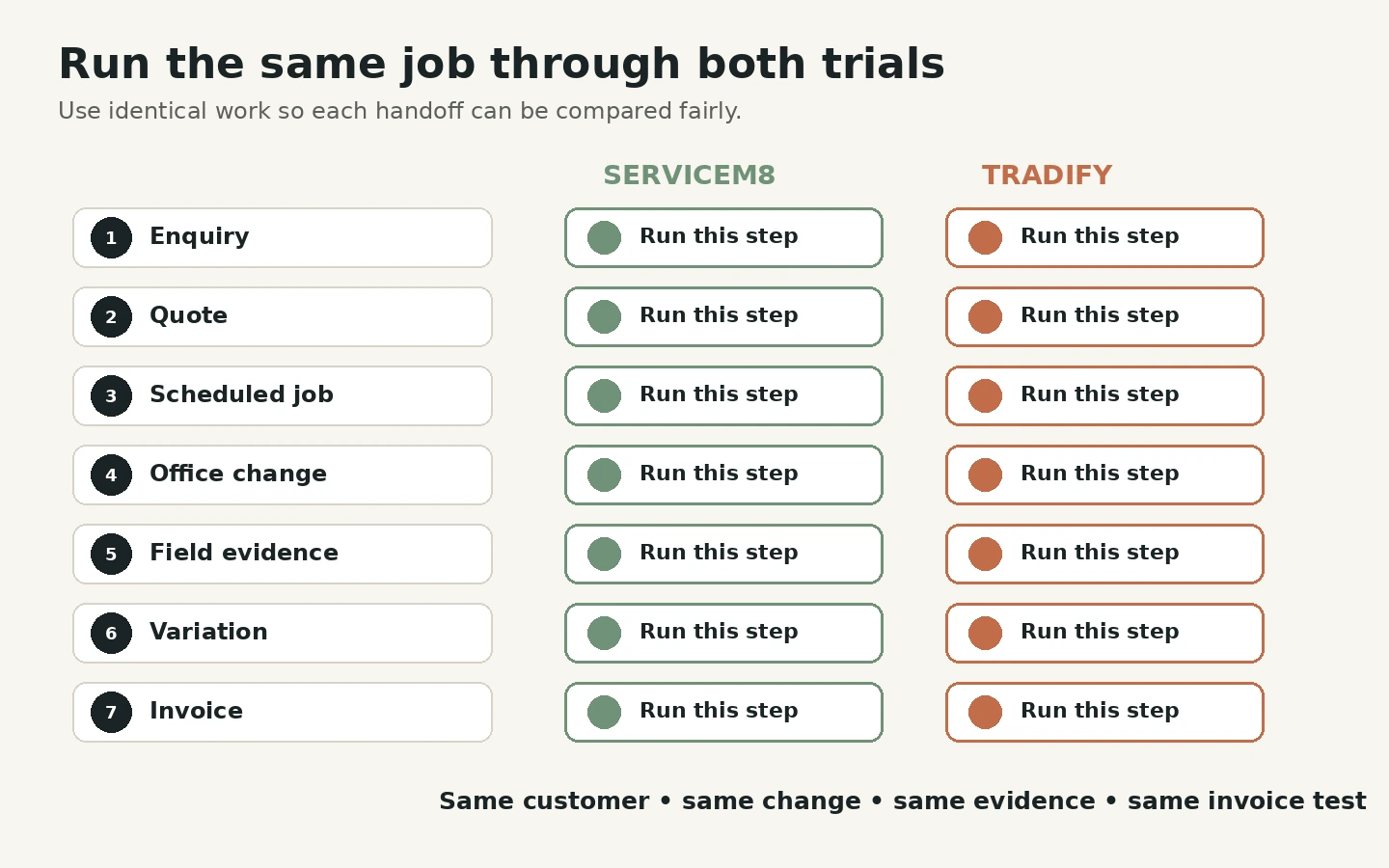
The workflow descriptions overlap, so the useful test is how each behaves on your jobs. Watch how an enquiry becomes a quote and a scheduled job, how office staff communicate a change, how field evidence attaches to a job, how variations become charges and how invoices flow through to your accounts.
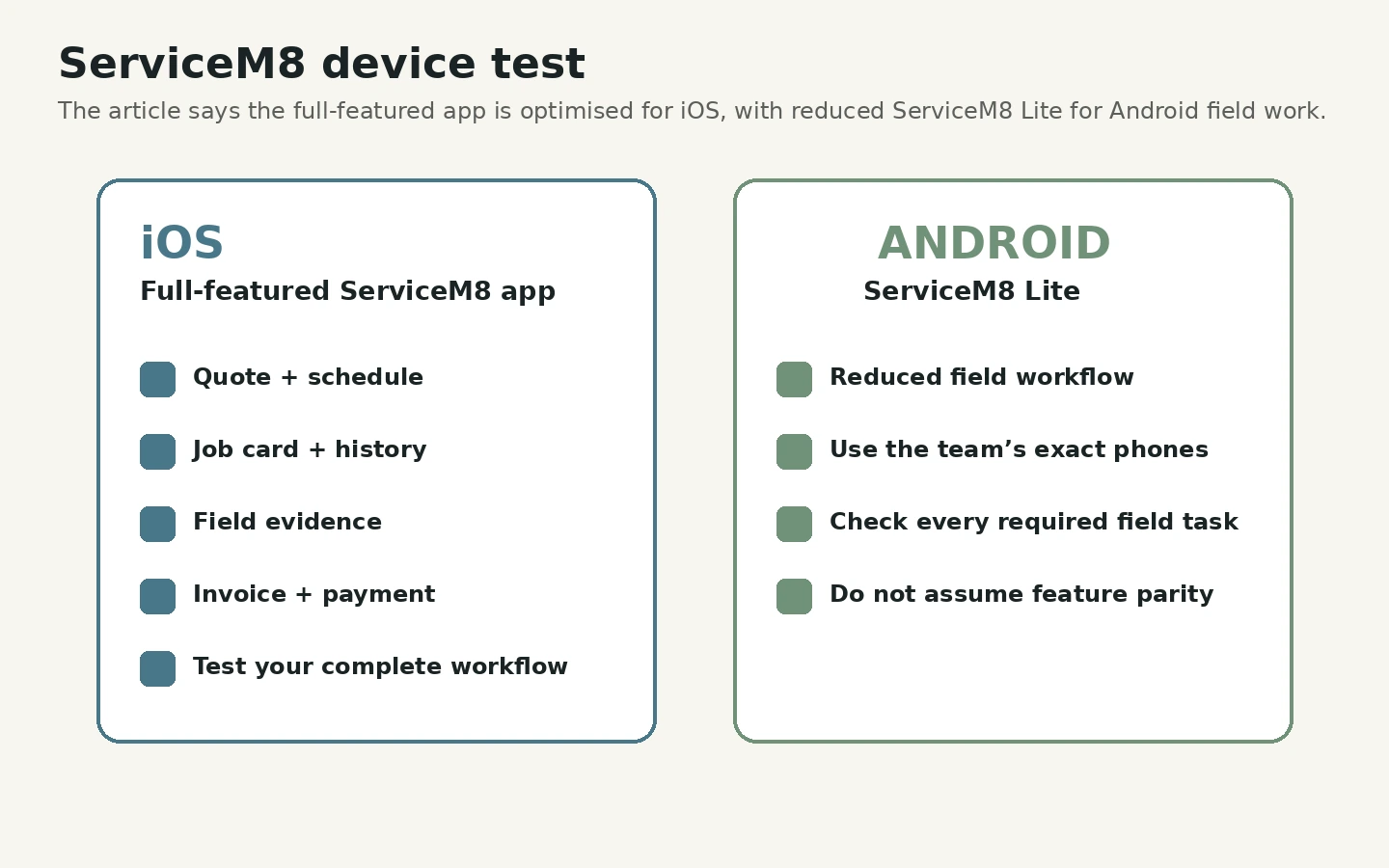
One practical point on devices: ServiceM8 says its full-featured app is optimised for iOS, with a reduced ServiceM8 Lite for Android field work. Test the exact phones your team uses.
Who should look at which first?
ServiceM8 deserves an early trial when unlimited users matter to your budget, or its published workflow matches how you work. That doesn't prove it will be cheaper, because the features you need may call for a higher plan.
Tradify deserves an early trial when its trade-focused workflow, its per-user pricing and promoted areas such as enquiry tracking and subcontractor management fit your business. Per-user pricing can also make costs simple to allocate for a small, stable team.
Let your own jobs decide
Trial both with the same script, so the comparison is fair:
- Create one service job and one larger quoted job.
- Reschedule after the customer has been notified.
- Add field notes, photos, time and materials from your phone.
- Add and approve a variation.
- Issue an invoice, record a part payment and correct an error.
- Export customer and job data.
- Record every workaround and support question.
Use the same representative jobs and the same scoring method in both trials.
Verdict
Neither product is a universal winner. ServiceM8's unlimited-user UK pricing is worth testing if your team is growing, while Tradify's per-user model and trade-focused workflow may suit a smaller or more stable team. Compare the exact plans you'd need, and run the same start-to-finish trial in both. For the sums, use our cost guide, and to see how both sit alongside other options, read our Jobber alternatives guide.
Sources
Feature and audience information checked 3 September 2026. UK prices and currency conversion were rechecked on 27 September 2026.