
Software Basics
The 30-Minute Weekly Business Review That Shows How Your Trade Business Is Really Doing
Busy weeks hide problems. A thirty-minute weekly business review, five numbers and one question that shows how your trade business is really doing.
 13 min read

A weekly business review is thirty minutes, five numbers and one question, and it tells you more than a busy week ever will.
On Friday afternoon, you're tired. The week went fast. You did a lot of jobs, answered a lot of calls, fixed a lot of problems.
If someone asked, "How's the business doing?", you'd probably say, "Busy." And that would be true. But busy isn't a measurement. It doesn't tell you whether you made money, whether customers are paying, whether the quotes you sent are turning into work, or whether next month is looking thin.
This is where a weekly business review comes in. It's a short, regular habit of looking at a handful of numbers and asking one useful question. It takes thirty minutes, needs no special software and gives you something rare in a small business: a calm, clear picture of what's actually happening.
In this guide, you'll find the five numbers worth tracking, a simple way to run the review, and one question that tends to uncover problems before they become expensive.
Why busy is the most misleading word in a trade business
When you're running jobs all week, the day-to-day noise drowns out the bigger picture.
You might be busy and losing money, because the jobs you're taking don't cover their costs. You might be busy and short of cash, because customers haven't paid. You might be busy this week and empty next, because you've been too occupied to send quotes.
None of these show up in the moment. They show up weeks later, as a thin bank balance or a diary with gaps.
A weekly review changes the timing. Instead of discovering problems at the end of the month, or the end of the year, you catch them while they're small.
Think of it like checking your tyres before a long drive. A quick look doesn't take long, and it can prevent a bigger problem down the road.
There's another benefit, which is emotional. Many small business owners carry a vague worry that something is wrong, without knowing what. A regular review replaces the vague worry with specific information. Sometimes the information is good news. Often, it simply confirms that you're fine, and that alone is a relief.
The five numbers worth knowing every week
You could track fifty things. You'd stop after a fortnight. The trick is to choose a few that tell you the most.
Here are five that work for most small trade businesses.
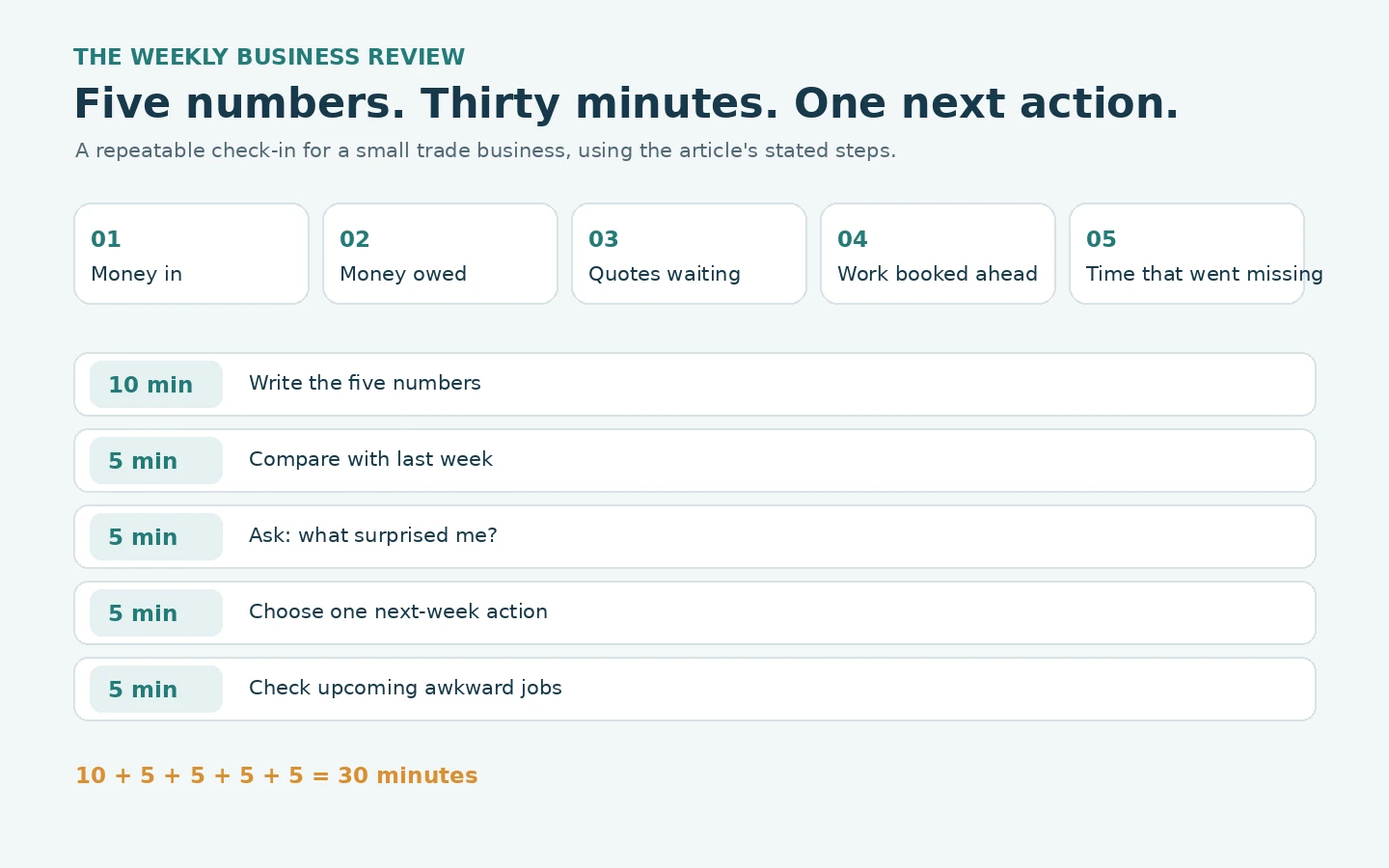
1. Money in. How much did you invoice and how much did you actually receive this week? Two numbers, not one. They show whether work is turning into cash.
2. Money owed. What is the total of unpaid invoices, and how many are overdue? This tells you how much of your hard work is sitting in other people's bank accounts. Our guide to chasing late payments covers what to do about it.
3. Quotes waiting. How many quotes are out, what are they worth, and how old are they? This is your future work, and it goes cold quickly. Our guide to writing quotes that win jobs explains why timely follow-up matters.
4. Work booked ahead. How full is your diary for the next two to four weeks? This tells you whether you need to find more work or turn some away.
5. Time that went missing. Roughly how many hours this week were spent on things that earned nothing, such as long drives, return visits, waiting and fixing mistakes? You don't need a precise count. An honest estimate is enough.
That's it. Five numbers, each answering a simple question.
Write them down in the same place every week. A notebook, a spreadsheet or a note on your phone will do. After a month you'll have a trend, and that's where the real value comes from.
How to run the thirty minutes so it doesn't turn into another chore
A review that feels like a burden won't last. Keep it short, predictable and slightly pleasant.
Pick a regular time. Friday afternoon works for many people. The week is fresh, and you can close it off before the weekend. Others prefer Monday morning to plan ahead. Choose whichever you'll stick to.
Set a timer. Thirty minutes, no more. If you run over, you'll dread it next week.
Have a fixed order. Following the same steps each time makes it quick. Try this one:
- Write down the five numbers (ten minutes).
- Compare them with last week (five minutes).
- Ask the question below (five minutes).
- Pick one thing to do next week (five minutes).
- Check upcoming jobs for anything awkward (five minutes).
Make it comfortable. Take a cup of tea, sit somewhere quiet and turn your phone to silent. A small ritual helps.
Keep it private. This is your business's check-up. If you have a partner or a team member who helps, share it with them, but don't turn it into a meeting.
The first review may take longer, because you're finding where the numbers live. By the third week, it should take half an hour or less.
The question that finds problems before they cost you
After the numbers, there is one question to ask. It's the most valuable part of the whole review.
"What surprised me this week?"
It sounds almost too simple. But surprise is a signal. It means reality differed from your expectations, and that's where the lessons hide.
Maybe a job took twice as long as planned. Maybe a customer you expected to pay promptly didn't. Maybe a quote was accepted that you were sure would go quiet. Maybe the diary filled up faster than usual, or emptied.
For each surprise, ask a follow-up: "Why?"
If a job ran long, was it the estimate, the access, a missing part or something else? If a customer paid late, did the invoice go out late? If the diary emptied, did you stop sending quotes three weeks ago?
You won't always find an answer. But the habit of asking trains you to notice patterns. Over time, you'll see the same causes repeating, and those are the things worth fixing.
A related question is "What went well?" It's worth asking, because we naturally focus on problems. Knowing what's working helps you do more of it, and it makes the review something to look forward to rather than dread.
Reading the numbers like a story, not a spreadsheet
Numbers on their own are dull. What matters is what they tell you when you put them together.
Here are some common patterns and what they might mean.
Money in is high, but money owed is growing. You're doing the work but not collecting it. Look at your invoicing speed and chasing routine.
Quotes waiting is large and old. You're sending quotes but not following up, or your quotes are slow. The work you've already earned the right to is sitting idle.
Work booked ahead is thin. You may need to send more quotes, follow up on past customers, or check whether your online presence is working. Our guide to staying in touch with past customers is a good place to look.
Work booked ahead is very full. You might be able to raise prices, or you may need help. Take care that overbooking doesn't harm quality.
Missing time is high. Look at where the hours went. If driving is the main culprit, see our guide to reducing drive time between jobs.
Everything looks fine but you feel stretched. This is also information. It may mean that you're working long hours to keep things going, and that the business isn't yet paying you fairly for them.
Don't try to draw conclusions from one week. A single bad number means little. A trend over four to six weeks means a lot.
How to keep the numbers without spending your evenings on them
The biggest obstacle to a weekly review is data entry. If the numbers take hours to find, you'll give up.
The solution is to make the numbers easy to get.
If you use job-management or accounting software, check what reports it offers. Many show outstanding invoices, quotes awaiting a decision and upcoming jobs. Features and plans differ between products, so ask each provider what's available and test the reports with real data. If a report takes five clicks to find, set up a shortcut or note down where it lives.
If you use a spreadsheet, keep a simple tab with one row per week and a column for each of the five numbers. Add a row on Friday. That's all.
If you use paper, keep a page per week in a notebook. Write the five numbers and the answer to the question. In a month, you'll have a record.
The point isn't perfect accuracy. If a number is approximate, say so and move on. A rough figure you record every week is more useful than an exact one you do once.
You can improve the data over time. For now, the goal is a habit, not a system.
Our guide to choosing simple field-service software suggests asking, in any trial, how quickly you can see overdue invoices, open quotes and upcoming work, since those are the numbers a review relies on.
The one-action rule: turn each review into a single change
A review is only useful if it leads to something. But trying to fix everything at once leads to nothing.
The one-action rule is simple. At the end of every review, choose one small thing to change next week.
Examples:
- Call the two customers with the oldest unpaid invoices.
- Send follow-ups to every quote more than five days old.
- Block out a morning for admin.
- Ask three recent customers for reviews.
- Check the price of one common job against its real cost.
- Plan next Tuesday's route by area.
Write it at the top of next week's page. When you do the next review, the first thing you check is whether you did it.
This works for several reasons.
It's achievable. One action fits into a busy week.
It builds momentum. Fifty-two small changes add up.
It keeps the review honest. If you find the same action appears week after week, you know it's either too big or not important.
It gives the review a purpose. You aren't just collecting numbers. You're using them.
If you want to be more ambitious, pick one action per area: money, work, time. But start with one.
What a month of reviews will teach you
After four weeks, something interesting happens. The numbers begin to tell stories you couldn't see before.
You might notice that Mondays are always light on enquiries, and decide to schedule your follow-ups then. You might notice that the same type of job keeps appearing under "missing time", and decide to price it differently. You might see that money owed climbs every month-end, and set a reminder to chase earlier.
You might also notice good things: a steady stream of quotes turning into work, a drop in late payments after you changed your invoice, a calmer diary after you started grouping jobs by area.
At the end of the month, add a short summary. Three lines are enough.
- What improved?
- What got worse?
- What do I want to try next month?
This is also a good time to look at the bigger picture. Are you earning what you need? Our guide to working out your hourly rate can help you check whether your prices match the business's needs.
Reviews work best as a cycle: look, learn, adjust, repeat. They don't have to be dramatic. A small improvement every week is more powerful than a big plan that never happens.
When you work with a partner or a small team
If you share the business with a partner or employ people, the review can include them.
A few suggestions:
Keep it short. A fifteen-minute conversation, using the same five numbers, is plenty.
Share the same numbers. Everyone should see what you see. It builds trust and a shared sense of how the business is doing.
Invite observations. Field staff often know why a number looks the way it does. "The reason the job ran long was that the customer wasn't in" is information you might not get otherwise.
Celebrate good weeks. When things go well, say so. It makes the habit more enjoyable.
Avoid blame. The aim is to understand, not to find fault. If a number is poor, ask what got in the way.
If you have a partner who handles the money side while you handle the work, a weekly review is also a good way to keep both of you informed. It prevents the situation where one person is surprised by the other's bad news.
Teams that review together tend to spot problems earlier, because more eyes are on the numbers.
Mistakes that make weekly reviews fizzle out
Most review habits die within a month or two. Here are the common reasons, and how to avoid them.
Trying to track too much. Stick to five numbers. You can add more later.
Making it too long. Thirty minutes is the limit.
Doing it only when things are bad. If you only review in a crisis, you won't have a baseline.
Not doing anything with the results. Use the one-action rule.
Skipping weeks. One missed week isn't a disaster, but a pattern of skipping is. Put it in your diary like a customer appointment.
Judging yourself harshly. The review is information, not a verdict. Be curious, not critical.
If you do miss a week, simply start again. There's no need to catch up on the whole backlog.
A sample page from week three
Here is what a single week's entry might look like, using hypothetical figures.
Money in: invoiced $2,400, received $1,900. Money owed: $3,100 outstanding, two invoices overdue. Quotes waiting: six out, worth about $5,200, oldest nine days. Work booked ahead: three weeks, with two gaps on Thursdays. Missing time: about six hours, mostly driving and one return visit.
Surprise: a quote I expected to lose was accepted within an hour. One action: call the two overdue customers on Monday.
It takes up less than half a page. Yet look at what it tells you. Cash is trailing invoices, one quote is getting old, and the diary has a pattern of Thursday gaps worth filling.
A page like this, repeated for a month, shows trends no single week can. That is the point of the exercise: small, regular, honest.
Weekly review questions, answered before you start
Is thirty minutes really enough?
For a small trade business, yes. If it takes longer at first, that's because you're setting up. It should shrink as you get used to it.
What if I don't have the numbers?
Start with estimates. A rough figure is better than none. Over time, improve how you collect them.
Should I do it weekly or monthly?
Weekly catches problems early. Monthly is better than nothing, but things can slip for a long time between checks.
Do I need software for this?
No. A notebook works. Software may make some numbers quicker to find, but check the features and plans with each provider before relying on them.
What about accounts and tax?
The weekly review isn't a substitute for proper accounts. It's a practical check-in. Ask your accountant about the formal records you need to keep.
Your first review can happen on Friday
A weekly business review is a thirty-minute habit that replaces vague worry with clear information.
Track five numbers: money in, money owed, quotes waiting, work booked ahead and missing time. Ask what surprised you. Choose one action for next week. Keep it simple, keep it regular and keep it private if you like.
Your first review can happen this Friday. Set a timer for thirty minutes, write down the five numbers as best you can, and answer the question. You'll probably learn something you didn't expect, and you'll start next week knowing exactly where you stand.