
Costs & Pricing
How to Work Out Your Hourly Rate as a Tradesperson (From Your Real Costs)
Your rate isn't what you want to earn per hour. It's what the business needs per billable hour. How to work it out from your real costs, step by step.
 14 min read

To work out your hourly rate as a tradesperson, start from what the business needs, not from what other people charge.
Where did your hourly rate come from?
If you're like many tradespeople, the honest answer is something like this. You started out, asked around, found out what others in the area were charging, and picked a number slightly below the middle. Then you raised it a bit when you felt brave, or when a customer said "that's cheap."
There's nothing shameful in that. Most of us price from the outside in. But it means your rate is a guess about the market, not a calculation of what your business needs. When costs rise, or the year turns out slower than planned, you can find yourself working flat out and still struggling to see where the money went.
This guide shows you how to work out your hourly rate as a tradesperson from your own costs, one step at a time. You'll meet three kinds of hour, only one of which you can charge for, and an idea about those hours that explains why a rate that looks generous on paper can leave you short. There's a worksheet at the end you can fill in tonight.
Why "what others charge" is the wrong place to start
Looking at other people's prices feels sensible. After all, customers compare. If you charge double the going rate, you'll struggle.
But the market rate is only half the picture, and it's the half you can't control. The other half is what your business needs to survive and grow, and that's entirely yours.
Consider the problem with copying.
You don't know their costs. They might own their van outright, work from home, have a partner earning a second income or be willing to take less. Your situation is different.
You don't know their results. A competitor with a low price might be struggling too.
You don't know their hours. They may be working seventy-hour weeks to make a modest rate work.
A rate based on someone else's guess carries all their assumptions with it.
The better approach is to start with your own numbers, and then compare with the market. That way, if the market rate is lower than your calculation, you'll know exactly how much you're giving up. That is useful information, whichever way you decide.
The three kinds of hour (and only one pays)
Here is the idea that changes most people's thinking.
You have three different kinds of hour in your working year.
Paid hours. The hours you work, from the moment you start to the moment you finish. This is the big number: forty-five, fifty, sixty a week.
Working hours on site. The hours you spend doing the actual job, with tools in hand.
Billable hours. The hours a customer pays for.
These aren't the same. Between paid hours and billable hours, a lot goes missing: driving, quoting, buying parts, invoicing, answering the phone, chasing payments, tidying the van, training, waiting for access, and the odd cancelled job.
Imagine a week in which you work fifty hours. Perhaps thirty are on site. Of those, maybe twenty-six are charged to customers, once you allow for a call that ran over and a quick fix you didn't bill.
You've worked fifty hours. You've billed twenty-six.
If you charge $40 an hour, you've earned $1,040 that week. But your real earnings per hour worked are just over $20. The rate you quote and the rate you earn are very different numbers.
This is why a rate that looks fine can leave you short. It's applied to only a portion of your time, while the costs apply to all of it.
The honest question isn't "what do I want per hour?" It's "what does the business need, spread across the hours I can actually bill?"
Step one: add up what the business has to earn in a year
Start with the total, because everything else follows from it.
You need to list what the business must bring in over twelve months. Group the items into four buckets.
Your wage. What do you need to take home? Think about what a fair pay for your skills and responsibility looks like, rather than what's left over.
Business running costs. Van, fuel, insurance, tools and equipment, software, phone, accounting, memberships, training, marketing, uniforms, protective equipment, and anything else the business pays for year-round.
Setting aside for tax and other obligations. Different countries and structures work differently. Check the official guidance or ask your accountant what you need to set aside, so that you don't treat the whole payment as spendable.
A cushion. Money for slow months, repairs, replacing tools, growth and bad luck. Even a modest allowance helps.
Add them up. Here's a hypothetical example, with round numbers chosen only to show the arithmetic.
- Your wage: $36,000
- Business running costs: $14,000
- Tax and obligations set aside: $8,000
- Cushion: $4,000
Total the business needs to earn from labour: $62,000.
That's the number you'll spread over your billable hours. If it surprises you, good. Many people discover it's higher than they'd imagined, because the business costs are easy to forget.
Materials are usually handled separately, since you charge for them on top. We'll come back to that in a moment.
Step two: count the hours you can really bill
Now the harder part. How many billable hours do you have?
Begin with the calendar.
Take the number of weeks in a year, and subtract the weeks you won't work: holidays, bank holidays, training, and an allowance for illness or bad weather. Be realistic. If you take four weeks' holiday and allow for another week or two of lost time, you're working about forty-six weeks.
Next, decide how many hours a week you want to work. Not how many you're able to, but how many you want over the long run. Forty-five, perhaps.
Multiply: forty-six weeks by forty-five hours is 2,070 paid hours.
Now estimate the share of those hours you can charge. This is the "billable ratio", and it's the most important figure in the whole exercise.
To estimate yours, look at a typical week and ask how many hours were charged to a customer. Total up your last four weeks if you have records. Our job costing guide shows how to check a job against its time.
For many small trades, the share is well under the full week, because travel, quoting and admin take up so much time. Your own ratio could be higher or lower. Use your own records rather than a guess.
For the example, say you can bill about 60 percent of your paid hours. That's 1,242 billable hours.
If your records show a lower figure, use it. If you think you can improve it, plan for the improvement but start with today's truth.
Step three: divide, and look at the number
Now the simple part.
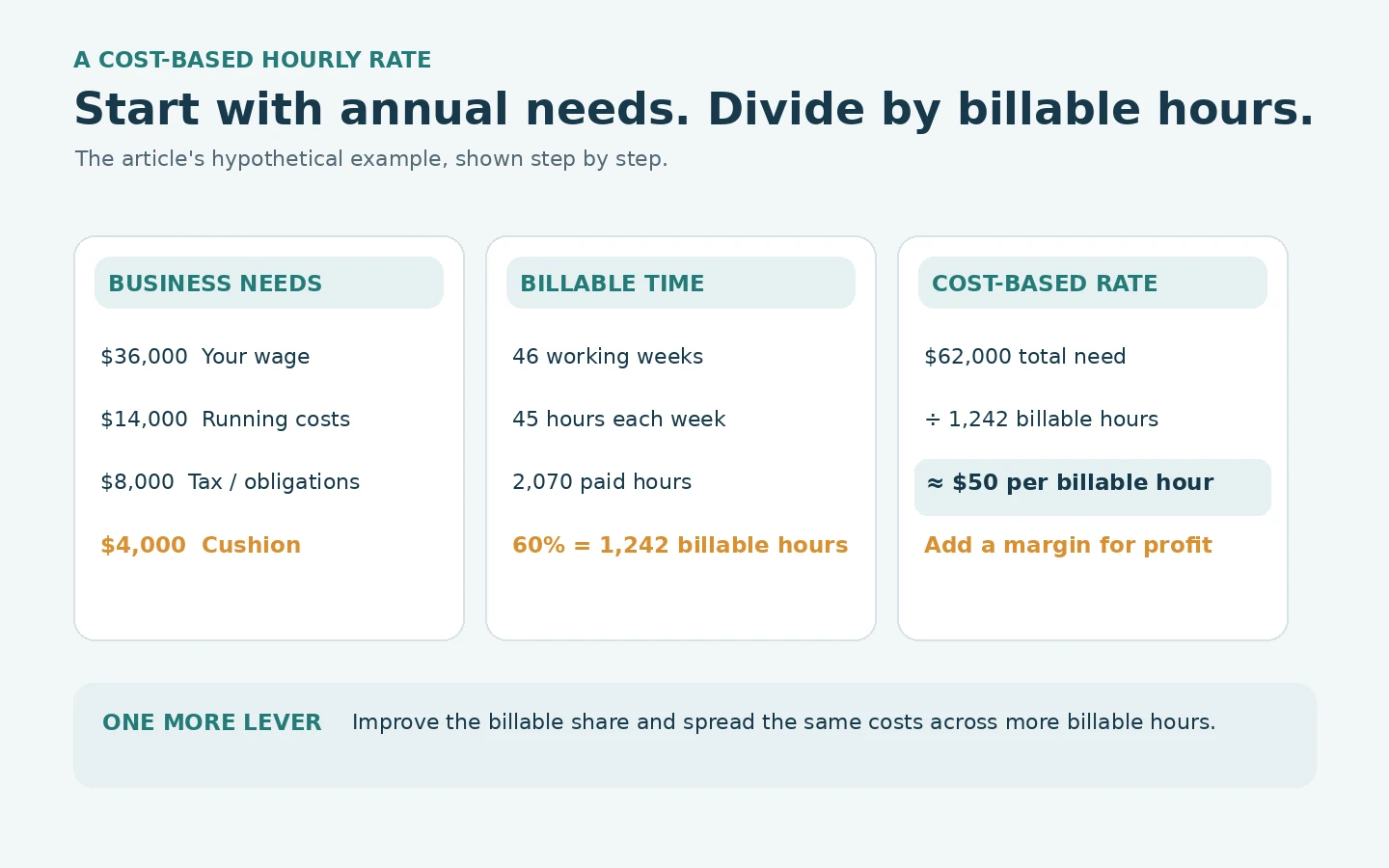
Take the total the business needs, and divide it by billable hours.
$62,000 divided by 1,242 is about $50.
That's your cost-based hourly rate for labour: roughly $50 an hour, in this hypothetical case.
Compare it with the figure from the earlier example of someone charging $40. That person billed $40 on 1,242 hours and brought in about $49,700, well short of the $62,000 the business needed. They'd have covered their wage and most of their costs, but not the tax allowance or the cushion. They might feel busy all year and wonder why there was nothing left.
This is the quiet cause of a lot of frustration. The rate wasn't a disaster. It just didn't match the hours.
Take a moment with your own figure. Does it feel high? Low? Do you recognise it from what you charge now?
If it's higher than what you currently charge, don't panic. We'll talk about what to do in a moment. If it's lower, check that you haven't left something out.
The two levers that move your rate, and the one people forget
Once you have a number, you can see how to change it. There are two obvious levers and one that people tend to overlook.
Lever one: charge more per hour. This is the obvious one. Raise the rate until the sums work. It's the most direct, and sometimes the right answer.
Lever two: cut costs. Trim the business costs that don't earn their keep. A cheaper insurance quote, a more efficient van, fewer unused subscriptions. Small savings add up, but they rarely close a big gap.
Lever three, the forgotten one: raise your billable ratio. If you can lift billable hours from 60 to 70 percent of paid hours, you have more hours to spread the costs over. The same $62,000 divided across 1,449 hours gives about $43 an hour instead of $50.
That is a significant drop in the rate you need, without lowering your income.
How do you raise the ratio? By attacking the hours that don't earn. Reduce driving with area-based booking, as in our guide to reducing drive time between jobs. Cut return trips with better van stock. Speed up quoting with a price book. Reply to enquiries faster so you fill gaps. Handle admin in a routine rather than scattered through the day.
This is a hopeful message. You aren't stuck with a high rate or a long week. Part of the answer is working smarter within the hours you already have.
Charge-out rate versus labour cost: two numbers, two jobs
People often mix up two different figures. It's worth separating them.
Labour cost is what an hour of your work costs the business. It's the number you use inside the business to work out whether a job made money. It includes your wage and a fair share of overheads.
Charge-out rate is what you quote to customers. It includes the labour cost, plus a margin for profit, risk and growth.
In our job costing guide, the example used an internal labour cost per hour to see whether a job paid. That figure sits below the charge-out rate.
The calculation in this guide gives you something close to a cost-based rate. If you add a margin on top for profit, you arrive at a charge-out rate.
Why does the distinction matter? Because you can't judge a job by the charge-out rate alone. If a job takes longer than quoted, the question is whether it still covers your labour cost. If it doesn't, you've lost money, even though the invoice looked normal.
Keep both numbers written down somewhere. They answer different questions.
What about helpers, apprentices and subcontractors?
If you employ or use other people, their hours need their own rates.
For an employee or apprentice, the cost to you is more than their wage. It includes the extra costs the employer carries, such as pension contributions, insurance, training, tools and holiday pay, which vary by country. Check the official guidance or ask your accountant. Add a share of overheads, and consider their billable ratio too.
For a subcontractor, the cost is what you pay them, but you'll also want to add your own management time and risk. We cover this in our guide to using subcontractors without losing track of money or quality.
A common mistake is to charge a helper's time at a low rate because "they're less experienced". But the costs you carry are the same, and sometimes higher while they're learning. Work out their cost-based rate with the same method, and see what it tells you.
If you employ several people, this exercise can reveal which roles generate profit and which are carried by others. That's useful information, not a judgment.
Hourly rate, day rate or fixed price: when each makes sense
Having a rate doesn't mean you must always charge by the hour.
Hourly charging suits uncertain work, such as fault-finding, where you can't say how long it will take. It's fair to both sides, but customers may worry about an open-ended bill.
Day rates suit longer jobs and work where you're on site all day. They're simple to explain. Check that your day rate reflects the real value of a day, not just eight hours at the hourly rate, because a full day often involves less wasted time.
Fixed prices suit work you can define clearly. You use your hourly rate to build the price, and then you quote the total. If you're quick, you benefit. If you're slow, you absorb the risk.
Many businesses use all three. The hourly rate is the foundation, and the others are ways to package it.
A fixed price built on an honest hourly rate is the most customer-friendly of the three, because customers know the total in advance. It's also the main way a price book works.
Sense-checking against the market (without panicking)
Now it's time to look outward.
Compare your calculated rate with what's charged locally. You may find it's close, higher or lower.
If it's close, you're in good shape. You can charge what you need and remain competitive.
If it's lower than the market, you may have room to charge more than your minimum. Don't undersell yourself just because you could.
If it's higher than the market, don't simply cut your price to match. Ask three questions first.
- Could I raise my billable ratio and bring the required rate down?
- Could I reduce costs without hurting quality?
- Is there a part of the market that values what I offer, such as faster response, better communication or a specialist skill, and is willing to pay more?
Sometimes the answer is that your area really doesn't support the rate you need. That's hard to hear, but better to know. It may mean changing the type of work you take, the area you cover or the way the business is structured.
Whatever you decide, you'll be doing it with your eyes open, rather than slowly discovering it at the end of the year.
Our guide on raising your prices without losing your best customers covers how to move from the rate you charge now to the rate you need.
Your worksheet: fill this in tonight
Here's the whole method on one page. Grab a pen.
Part one: what the business needs 1. My wage for the year: __ 2. Running costs for the year: _ 3. Tax and obligations to set aside: 4. Cushion: 5. Total needed (add 1 to 4): ___
Part two: hours I can bill 6. Weeks I'll work: __ 7. Hours per week I want to work: _ 8. Paid hours (6 multiplied by 7): 9. Share of those hours I can realistically bill: % 10. Billable hours (8 multiplied by 9): ___
Part three: the rate 11. Cost-based hourly rate (5 divided by 10): __ 12. Margin I'd like to add for profit and growth: _ 13. Charge-out rate: ___
Part four: sense-check 14. Local market rate: __ 15. Gap: _ 16. One thing I could do to raise my billable ratio: ___
Keep it somewhere you can find it. Revisit it once a year, or whenever your costs change.
The hourly rate questions behind most worksheets
What is a normal hourly rate for a tradesperson?
It depends on the trade, the region, your experience and the type of work. Rather than chase a "normal" figure, calculate your own and compare it with local prices.
Should I charge VAT or sales tax on top?
That depends on your registration and country. Check the official guidance or ask your accountant. Be clear on whether your quoted rate includes tax.
Why does my rate need to be so much higher than my wage per hour?
Because it has to cover your overheads, tax allowance and unbilled hours, not only your pay for the time on site.
Do I charge for travel time?
Many businesses do, either as a separate charge or built into a minimum charge. Our guide to the minimum call out charge explains how.
How often should I review my rate?
At least once a year, and whenever your costs change noticeably.
Fill in the worksheet tonight
Your hourly rate is not what you'd like to earn per hour. It's what the business needs, divided by the hours you can really bill.
Add up the year's costs and wage, count your billable hours honestly, divide, and then add a margin. If the answer is higher than you charge now, you have two choices: raise the rate, or raise the share of your time that earns. Often, you can do some of both.
Tonight, fill in the worksheet. It takes about twenty minutes. The number you get may be uncomfortable, but it will be yours, and it will be based on your own business rather than someone else's guess.