
Software Basics
How to Win Repeat Customers in a Trade Business Without Being Annoying
Your best next job is probably someone you already worked for. How to win repeat customers in a trade business with reminders people actually welcome.
 13 min read

Repeat customers are the cheapest work you will ever win, and most trade businesses lose them through nothing more than silence.
Think about the last time you needed a plumber, an electrician or someone to fix the guttering. Did you search for a new name, or did you try to remember who did the work last time?
Most people do the second. They'd rather call someone they already know. The trouble is that after a year or two, they can't remember the name, or the phone number, or whether the person was any good. So they search again, and the previous tradesperson loses a customer they never meant to lose.
That's the quiet leak in many trade businesses. Good work happens, a customer is pleased, and then silence. Nobody follows up, and the relationship fades. This guide is about turning that around. You'll see how to win repeat customers in a trade business using reminders people are glad to get, what to say, when to say it, and an idea about "reasons to call" that makes the whole thing feel natural rather than salesy.
Why a past customer is worth more than a stranger
Winning a new customer takes effort. You have to be found, answer the enquiry, visit, quote and persuade. Each step costs time and sometimes money.
A past customer has already done most of that. They know you, they've seen your work and they've paid you. If they need something again, the path is short.
Past customers have other advantages.
They're easier to quote. You know the property, the history and what's already been done.
They're more likely to accept. Trust is already in place.
They talk. A satisfied customer tells neighbours, family and colleagues. A forgotten one tells nobody.
They bring variety. Someone who hired you for a boiler may later need a bathroom, a tap or a recommendation.
None of this means you should neglect new customers. It means that the people who already know you are your most valuable audience, and most of us do almost nothing to stay in touch with them.
The good news is that you don't need a big marketing plan. You need a short list of people, a few good reasons to get in touch and a simple routine.
The mistake that makes follow-ups feel pushy
Before the how, a word on the why it so often goes wrong.
Most follow-up messages sound like sales pitches. "Hi, it's been a while! We're offering a discount on boiler services this month." The customer reads it, thinks "they just want money", and ignores it.
The problem isn't following up. It's the reason for doing it. A message whose only purpose is to get work from the customer feels one-sided.
A message that helps the customer feels completely different. "Your boiler was last serviced a year ago, so it might be time for a check." That's useful information. It's something the customer might have forgotten, and might be glad to be reminded of.
This is the idea at the heart of repeat business: give people a reason to hear from you that is about them.
A good reason to call is:
- Relevant. It relates to something you actually did for them.
- Timely. It arrives at a moment when it makes sense.
- Helpful. It saves them effort or avoids a problem.
- Easy to act on. It tells them what to do next.
If a message meets those four tests, most customers won't see it as selling. They'll see it as good service.
Finding your reasons to call: the six that work for most trades
Not every trade has the same natural reasons to follow up. But most can use some combination of these six.
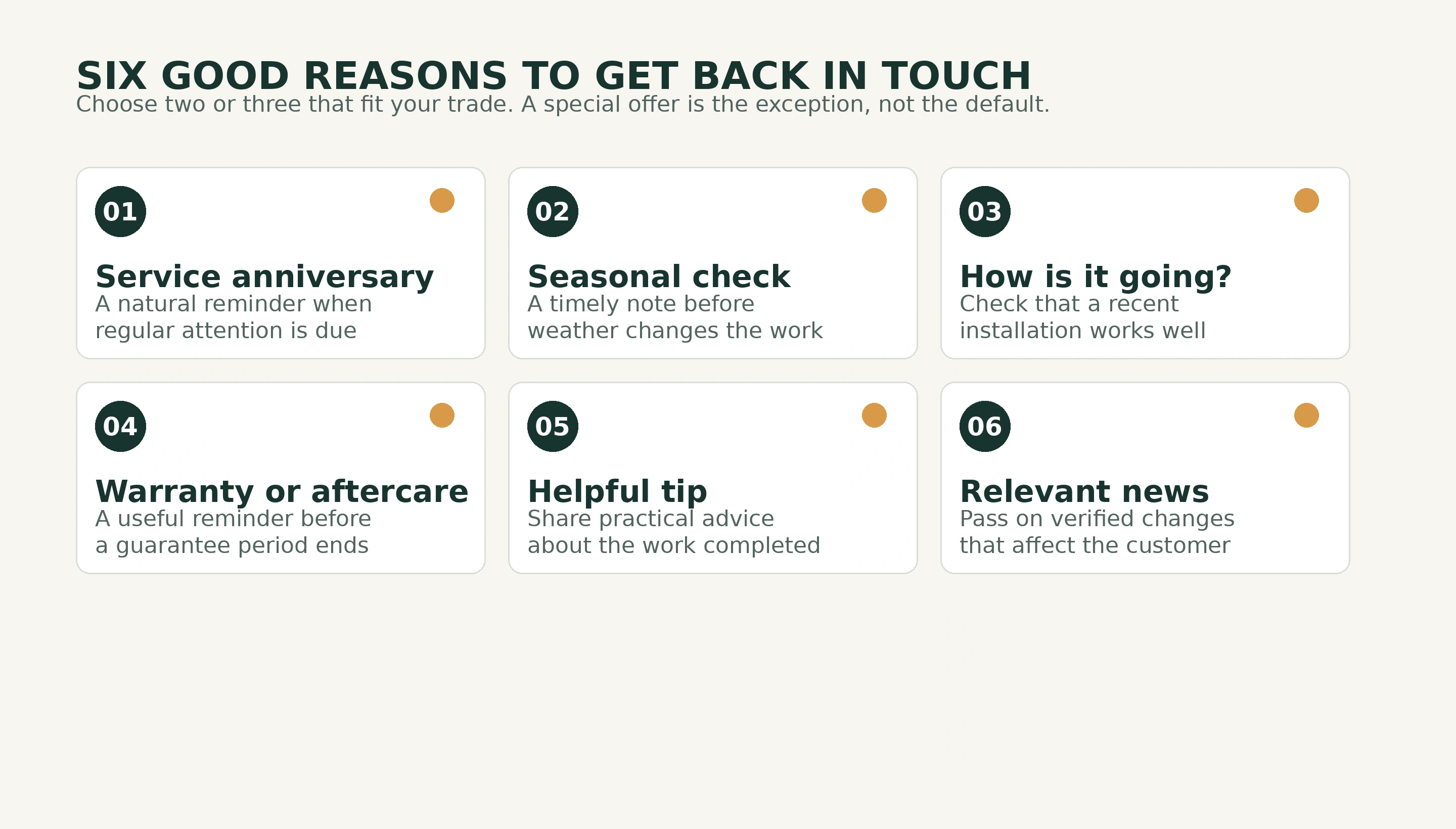
1. The service anniversary. If your work needs regular attention, such as a boiler, an alarm, a heat pump, an electrical test or a pest control visit, a yearly reminder is the most natural one. "It's a year since we serviced your boiler. Would you like us to book the next one?"
2. The seasonal check. Some work suits certain seasons. Gutters before winter. Air conditioning before summer. Outdoor taps before the frost. A short message before the season is helpful, not pushy.
3. The "how's it going?" check-in. A few weeks after a big job, ask how things are. "Just checking everything is working well after the new shower went in." This catches small problems and shows you care.
4. The warranty or aftercare note. If you gave a guarantee or aftercare advice, a reminder near the end of the period is helpful. "Your work was guaranteed for twelve months. If anything doesn't seem right, let us know before it ends."
5. The helpful tip. A short, useful piece of advice relevant to what you did. "A tip for your new tap: wipe it with a soft cloth to avoid limescale." It costs nothing and keeps your name in front of them.
6. The news that matters. Changes in rules, safety recalls or availability that affect them. Be careful to check facts from official sources before passing anything on.
Pick two or three that suit your trade. You don't need all six.
Notice what's missing from this list: "special offers". They can have a place, but they should be the exception, not the main reason you get in touch.
What to say: five short messages you can adapt
The tone should be friendly, brief and specific. Think of how you'd speak to a neighbour, not how a company would write to a customer.
The anniversary reminder. "Hi Sam, it's Alex from [business]. Just a quick note that it's a year since we serviced your boiler. Would you like me to book the next one? I've got a couple of slots in [month]. No rush, just wanted to flag it."
The seasonal check. "Hi Sam, with winter coming, it's a good time to check outside taps and exposed pipes. If you'd like me to take a look, just reply and I'll find a time."
The how's-it-going check-in. "Hi Sam, hope the new shower is working well. Just checking in a few weeks on. If anything seems off, let me know and I'll sort it."
The aftercare note. "Hi Sam, a quick reminder that the work on your bathroom is guaranteed for twelve months, which ends in [month]. If you've noticed anything, get in touch and I'll come and look."
The tip. "Hi Sam, a small tip for your new tap: wipe it with a soft cloth now and then to stop limescale building up. If you ever need anything else, I'm here."
What do these have in common?
- They use the customer's name and the actual job.
- They are short enough to read in a few seconds.
- They offer a clear next step, but don't demand one.
- They end warmly, with no pressure.
Always make it easy to say no. A line like "No problem if you've got it covered" lowers the pressure. You can also let people know how to stop hearing from you, depending on the channel and the rules where you work.
When to send them: the calendar that does the remembering
Having reasons is one thing. Remembering to act on them is another.
A simple system makes it painless. At the end of each job, make a note of the follow-up date and reason. For instance:
- Boiler service: remind in 11 months.
- New bathroom: check in after 3 weeks, guarantee reminder at 11 months.
- Outside tap fitted in summer: seasonal tip in October.
Then put those dates somewhere they'll prompt you. Options include:
- A calendar entry with the customer's name and the message you plan to send.
- A spreadsheet with columns for customer, job, date done and follow-up date.
- Job software that lets you set reminders on a customer or job. Many tools offer features like this, but what's included varies by product and plan, so check with each provider and test with a real customer before you depend on it.
Once a week, perhaps during your weekly business review, look at the upcoming follow-ups and send them.
The system doesn't have to be fancy. It has to exist. A list in a notebook that you check every Friday is far better than a clever system you forget about.
The customer list you already own, and how to wake it up
If you've been in business for a while, you may already have a list of past customers sitting in your invoices, your phone or your accounts. The problem is that it's scattered and unused.
Here's how to gather it.
Step one: collect names and contacts. Pull them from invoices, your phone contacts, emails and any software you use. A single spreadsheet is fine.
Step two: add what you did and when. One line per customer: the job, the date and anything useful, such as the boiler model.
Step three: sort by date. You'll see who you haven't spoken to in a long time.
Step four: choose a small batch. Don't message everyone at once. Pick ten.
Step five: send a personal message. Use one of the reasons above. If you haven't contacted someone for years, a simple "Hope you're well. I was reviewing my records and wanted to check the work we did in [year] is still giving you no trouble" works well.
Treat any customer data with care. Data protection rules vary by country and cover how you store and use personal information and how you contact people. Check the official guidance where you work, and ask an adviser if unsure. Only contact people in ways they would reasonably expect, and respect anyone who asks to stop.
If your list is a mess, our guide to moving your customer list into new software shows how to clean it up before you use it.
The one-reply rule: how to follow up without becoming a nag
A major worry about follow-ups is annoying people. A sensible rule keeps you safe.
Send one message. Wait for a reply. If there isn't one, stop, or send one gentle reminder a few weeks later at most.
Never send a series of increasingly urgent messages. It turns a helpful service into pressure.
Also think about frequency. If you've sent a message about a service reminder, don't follow it a week later with a seasonal tip. Space contacts out. Two or three a year is plenty for most customers.
And respect the answer. If someone says they've gone elsewhere or don't need anything, thank them warmly and note it. A gracious reply today might be a recommendation tomorrow.
The one-reply rule has a benefit beyond politeness. It makes you comfortable sending messages in the first place. When you know you won't hound anyone, the whole task feels lighter.
Making it personal when you've got a hundred customers
As the list grows, personal touches get harder. But a few habits keep messages human.
Use their name and the job. Even a standard template should include both.
Add one specific detail. "Hope the new kitchen is still looking great" takes seconds to add, and makes a difference.
Write like you speak. Avoid formal phrases. Read it aloud before sending. If it sounds stiff, loosen it.
Send from you. Where possible, send from your own number or email, with your name, rather than a generic company account.
Mix the channels. Some people prefer text, some email, some a phone call. Use what the customer has used with you.
Keep notes. If a customer mentioned their daughter's wedding or a trip abroad, note it. A line such as "Hope the wedding went well" is memorable.
Our guide to job notes that protect you in a dispute shows how to keep records you can use for both protection and personal touches.
Customers can usually tell the difference between a message written for them and one written for a list. The effort is small, and it pays back.
How to turn one happy customer into three
Repeat business isn't only about the same person coming back. It's also about the people they know.
There are gentle ways to encourage recommendations.
Ask at the right moment. When a customer says "that's brilliant", reply, "Thanks. If you know anyone else who needs a hand, I'd be glad to help."
Make it easy to share. Give customers a card, a message they can forward or a link to your reviews. Our guide to getting Google reviews as a tradesperson covers how to ask without feeling pushy.
Say thank you. A short note or message after a recommendation shows you noticed. Be careful with rewards: a small thank-you is fine, but check the rules of any platform and your own obligations before offering incentives.
Look at your neighbours. When you've done a job on a street, a polite note to nearby properties or a mention to the customer ("we're around until Thursday if anyone nearby needs anything") can lead to work close by.
Remember the pattern. People tend to recommend someone who made them feel looked after. The follow-ups in this guide are part of that.
You'll find that repeat business and referrals feed each other. Customers who hear from you appreciate you more, and customers who appreciate you tell others.
What to do when someone replies "not now"
Not every follow-up gets a yes. Many get a "not now", and how you respond decides whether the relationship lasts.
Thank them warmly. "No problem at all, thanks for letting me know." Never sound disappointed or pushy.
Ask if you may check in later. "Would it be all right if I got in touch again in the spring?" Most people say yes, and you now have permission and a date.
Note it. Add a line to the customer's record with the date and what they said. When the time comes, you can write, "Last time you mentioned the spring, so I wanted to check in."
Leave the door open. A final line such as "If anything changes before then, just give me a ring" costs nothing.
This sounds small, but it turns a polite refusal into the beginning of a longer conversation. Many of the best repeat customers come from people who said "not now" first and were treated well.
Questions about following up without being annoying
How often should I contact past customers?
Two to four times a year is usually plenty, and only when you have a genuine reason. More than that risks irritating people.
Is it okay to text customers?
Often yes, if they've given you their number for the job and the message is relevant. Rules differ by country, so check the official guidance and respect anyone who prefers not to be contacted.
What if a customer didn't leave a review or reply last time?
Don't take it personally. People are busy. A friendly follow-up costs little.
Should I offer discounts to bring people back?
Occasionally, perhaps. But reasons based on help and relevance tend to build better relationships than discounts.
Can software automate all this?
Some tools can send reminders and messages on a schedule. What's available depends on the product and plan, so ask each provider in writing and test the messages yourself.
Pick ten past customers and write one reason to call
Repeat customers don't happen by accident. They come from staying in touch in ways that help.
Give people a reason to hear from you: an anniversary, a seasonal tip, a check-in or an aftercare note. Keep messages short, personal and easy to ignore. Put the dates in a calendar so you don't have to remember. Send one message and respect the reply.
This week, pick your last ten happy customers and write down one reason to get in touch with each. Send the first three messages. You may be pleasantly surprised by how many reply, and how many say, "Funny you should mention that."